
Reviewed · ATHENS
Percy & Medusa: Family Mythology Treasure Hunt & Tour
Athens becomes a giant mythology game on this family treasure hunt, which links temples, theaters, hills, and old streets with short stories and riddles. You begin near Hadrian’s Arch and finish in Plaka, with the Narratologies app guiding much of the route between visits.
I like the hands-on format and the way it gives children a reason to look closely at monuments. I also like the included stop for warm Greek donuts, called lukumades, plus the chance to hear mythology explained in a way that works for mixed ages. The main consideration is pace: you cover many sites in about two hours, so this is an introduction rather than a full archaeological tour.
What makes this Athens treasure hunt worth considering

- A game across 11 landmarks: You move from the Temple of Olympian Zeus to Plaka, the Tower of the Winds, and the Monument of Lysicrates.
- A useful mix of human and digital guidance: A facilitator starts the game and holds the code that activates it, while the Narratologies app handles stories, clues, and directions.
- A genuine family focus: The puzzles give elementary and middle-school children something active to do, while adults can ask wider questions about Athens and Greek history.
- Lukumades are included: The food stop brings Greek donuts with honey and cinnamon, along with water.
- A small group size: The activity accepts no more than 15 people, which should keep the game easier to follow.
- A scenic finish in Plaka: The final coronation takes place at the well-preserved Monument of Lysicrates, close to Acropolis Metro Station.
How the Percy and Medusa game works

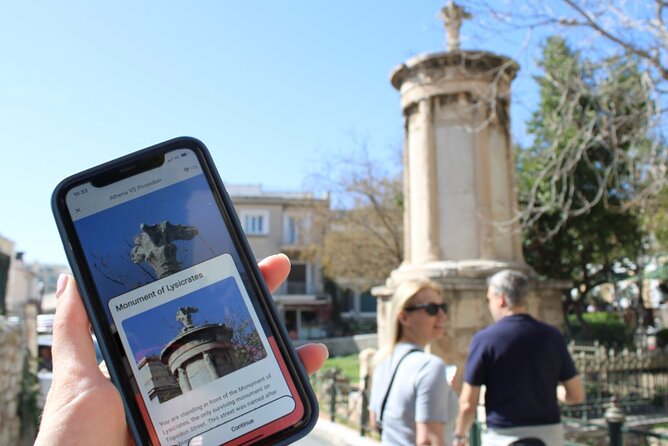
This is not a standard guide-led walk where you listen, take photographs, and move on. Instead, you follow a story about Greek gods, Percy, and Medusa while solving clues at each location. The app provides location-based stories, navigation, riddles, and a collection system for gems.
The facilitator has the magic code that unlocks the game. After booking, you receive information about the meeting point and a link to download the Narratologies app. I would install it before reaching Athens, as suggested, rather than using precious opening minutes to sort out a download.
The format allows the guide to step in where useful and lets the app carry the story between stops. That matters with children. A young participant can focus on finding the next clue, while an adult can pause to look at the monument or ask a question.
The experience is offered in English and uses a mobile ticket. The group limit is 15 people, a reasonable size for a game that depends on everyone hearing directions and sharing the excitement of a solved riddle.
More Family and Kids Games in Greece
- Greek Mythology Treasure Hunt for Kids – Athens Private Tour
★ 5.0 · 77 reviews - Athens: Family Mythology Treasure Hunt and Tour
★ 4.8 · 42 reviews - Athens: Percy Family Treasure Hunt & Tour
★ 4.8 · 19 reviews
Starting at the Temple of Olympian Zeus
The meeting point is the Arch of Hadrian, at Leoforos Vasilisis Amalias 50. From there, the first stop is the Temple of Olympian Zeus, where the story places the gods in a meeting and asks for divine help.
You spend about 10 minutes here. The app gives you a story about the monument, then presents a riddle pointing toward the next stop. The short visit is a good choice for a family game because it gives you the scale of the ancient site without trying to explain every column and building phase.
The temple is also a useful first lesson in how Athens mixes myth and archaeology. Children receive a clear task, while you get a quick look at one of the city’s major ancient remains. Admission to this stop is not included because no separate admission ticket is required for the activity.
A quick look at the Acropolis Museum
The route then reaches the Acropolis Museum for about five minutes. The stop focuses on the museum and its collection, followed by another riddle and a direction to the next point.
Be clear about what this means: the tour does not include a full museum visit. Five minutes is enough to point out the institution and its importance, but not enough to explore the galleries. If you want to see the sculptures and archaeological displays inside, plan a separate visit.
That short pause still has value. It places the Acropolis monuments in a wider setting and gives children another clue to solve before the route continues.
Walking along Dionysiou Areopagitou
Dionysiou Areopagitou is one of the most pleasant stretches of the route. This pedestrian street runs beside major ancient sites and presents some of Athens’ best-designed houses along the way.
You spend about 15 minutes here reading stories and solving more difficult riddles. The route also warns you to watch for Olympian gods who may be looking for you, a playful touch that helps children pay attention to the buildings around them.
I like this part because it connects the formal monuments with the city you can actually walk through today. You are not simply moving between ticket entrances. You are following a public street where ancient remains, modern homes, and views toward the Acropolis share the same setting.
The route is outdoors, so comfortable shoes and water make sense. The tour includes water at the food stop, but you may want your own bottle during the walk.
More Treasure Hunts in Greece
- The Acropolis Treasure Hunt: Licensed Guide + Interactive Puzzles
★ 5.0 · 60 reviews - Athens Urban Treasure Hunt w Food Stop
★ 5.0 · 16 reviews - Athens Family Mythology Treasure Hunt and Tour w Food Stop
★ 5.0 · 15 reviews - Treasure Hunt Around Acropolis— Private Group
★ 5.0 · 10 reviews
A sweet pause at LukumaΔes
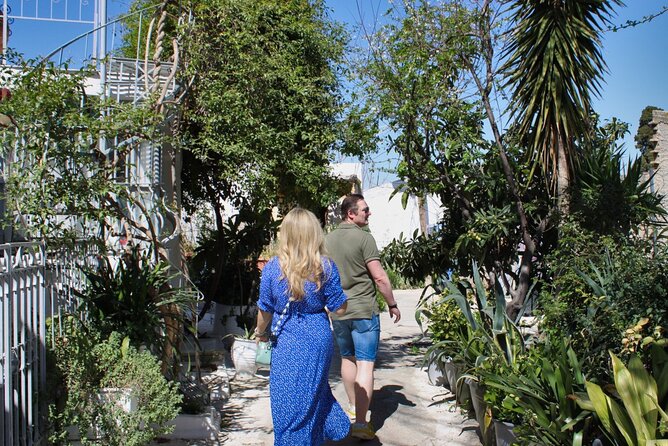
After the first set of clues, the treasure hunters stop at LUKUMAΔES for about 15 minutes. The included food is Greek donuts served with honey and cinnamon, plus water.
This is more than a snack break. A short food stop gives children a reward at the middle of the game and gives everyone a moment to reset before the ancient theater and hillside stops. The food is specific, local, and easy to share.
Drinks besides water are not included. If someone in your group wants another drink, budget for it separately. The supplied details also highlight savory pastry among the experience’s food themes, but the included food description specifies Greek donuts, honey, cinnamon, and water. I would count on the lukumades rather than assume an additional pastry is covered.
The Theatre of Dionysus and Herod Atticus Odeon
The Theatre of Dionysus receives about five minutes. This surviving ancient theater sits at the foot of the Acropolis, and the app gives you more information before sending you onward with another mission.
For children, this can be an easy point of connection. Theater is still familiar today, so the site offers a clear question: what did performance look like in ancient Athens, and why was this place important? The visit remains brief, so you will not receive a long account of ancient drama.
Next comes the Herod Atticus Odeon, another five-minute stop. This Roman odeon is described as a place of great importance, and the story prepares you for the Acropolis hill.
Again, the short timing is both strength and limit. You get a strong sequence of landmarks without spending the whole day at one site. But if your main goal is detailed archaeology, architecture, or theater history, you will need separate time at these places.
Areopagus for Athens and Parthenon views
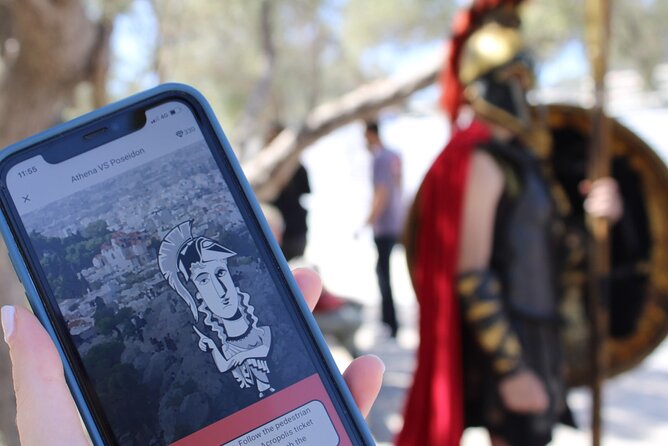
The route climbs to Areopagus, a small hill with views toward Athens and the Parthenon. You spend about 10 minutes looking for clues here.
This is one of the best spots for a visual reward. The setting helps children understand where they are in relation to the Acropolis, while adults get a memorable city view. The hill also makes the physical side of the tour more noticeable.
A moderate level of physical fitness is advised. The route includes walking and a hill, so this is not a sit-down activity. The supplied information does not promise accessibility details, and the physical requirement is worth taking seriously if anyone in your group has trouble with uneven or uphill walking.
Ancient Agora from above
The next stop is the Ancient Agora of Athens, seen from above, with about five minutes for a story and riddle.
The Agora was the working center of ancient Athenian life, so even a short explanation can add useful context. This is not a visit inside the archaeological site. Instead, you learn about it from an elevated viewpoint and continue the treasure hunt.
That distinction matters if you are planning a full day around ancient Athens. The game gives you a broad introduction to the Agora, but it does not replace entering the site and seeing its remains at close range.
Plaka turns the game into a neighborhood walk
The route enters Plaka, Athens’ oldest district, for about 20 minutes. This is the longest stop, and it includes several stories and riddles that bring you closer to completing the mission.
Plaka works well as the final neighborhood section because it feels different from the open archaeological spaces. Narrow streets, older buildings, small shops, and nearby monuments give the game a more everyday setting.
The activity also provides discount vouchers from local souvenir shops and museum gift shops. These are a modest extra rather than a reason to book, but they may be useful if you want a small keepsake after the game.
The route’s mixture of monuments and neighborhood streets is one of its practical strengths. You see important Athens sights while also getting a feel for the area where many people continue walking after the tour ends.
The Tower of the Winds and the final coronation
At the Tower of the Winds, you spend about five minutes learning about what is described as the first recorded weather station of humankind. The clue asks you to think about the building’s purpose and solve one more riddle.
This is exactly the kind of compact stop that suits a treasure hunt. The tower is unusual, visually clear, and linked to a simple idea that children can grasp: people have long watched and measured the weather.
The final stop is the Choragic Monument of Lysicrates, where the mission ends with a coronation ceremony. You spend about 10 minutes here, and the monument provides a satisfying finish rather than an abrupt goodbye.
The end point is in Plaka at Epimenidou 3, a short walk from Acropolis Metro Station. That makes it easy to continue into Plaka, head toward the Acropolis area, or use public transportation after the activity.
Price, timing, and what you receive
The price is $75.06 per person for about two hours. That is not the cheapest way to walk around central Athens, especially since the tour does not include admission to major museums or archaeological sites.
The value comes from the structure. You are paying for a designed family activity, the Narratologies app, a facilitator, location-based stories, riddles, navigation, the lukumades stop, water, and discount vouchers. If your children would lose interest during a conventional history talk, the game format can make the cost easier to justify.
You should not book this expecting a deep archaeological lecture or long indoor visits. Most stops last five to 15 minutes, with Plaka receiving about 20 minutes. The experience gives you a lively orientation to the Acropolis area and central Athens, not a complete study of each monument.
It is currently rated five out of five from six submitted ratings. The strongest praise focuses on the family format and the guides. Maria is described as able to move comfortably between questions from elementary and middle-school children. Konstas is praised for explaining Greek mythology alongside Percy Jackson and for handling wider questions about Athens and Greek history.
Guide assignments can vary, so you should not assume Maria or Konstas will lead your particular departure. Still, their reported strengths show what to look for: a facilitator who can keep the game moving while giving adults enough context to stay interested.
Who should book this experience
I would choose this for families with school-age children who already enjoy myths, riddles, or Percy Jackson. It also suits a mixed-age group where a standard walking lecture might work for the adults but lose the children.
It is a good first activity in Athens because it covers several central landmarks and ends near public transportation. You gain a mental map of the Acropolis area, Plaka, the Agora, and the surrounding streets.
I would be more cautious if you want extended monument visits, museum time, or a quiet architectural walk. The route is active, the clues keep you moving, and the two-hour length requires quick stops. Anyone joining should have moderate physical fitness.
The activity is offered only in English. The group can be as large as 15 people, though that is still small enough for a facilitator to manage the game.
Should you book Percy and Medusa?
Book it if you want your family to meet Athens through stories, movement, and puzzles rather than a conventional lecture. The strongest reasons are the clever route, the child-friendly challenge system, the included lukumades, and the ability of guides such as Maria and Konstas to connect mythology with modern questions.
Skip it if you want full entry to the Acropolis Museum, the Ancient Agora, or other major sites during the two-hour session. In that case, use this as a fun orientation, then plan separate visits with more time.
At $75.06 per person, the experience makes most sense when the game itself is the main attraction. For a family that needs history to feel active, that can be a fair price. For a specialist archaeology visit, it will feel too brief.
FAQ
Where does the treasure hunt start?
It starts at the Arch of Hadrian, at Leoforos Vasilisis Amalias 50 in Athens.
Where does the experience end?
It ends at the Choragic Monument of Lysicrates at Epimenidou 3 in Plaka, near Acropolis Metro Station.
How long does the activity last?
The experience lasts approximately two hours.
What language is offered?
The activity is offered in English.
How many people can join the tour?
The maximum group size is 15 people.
Is the Narratologies app included?
Yes. The app provides navigation, location-based stories, riddles, and a system for collecting gems.
Do I need to download the app before the tour?
You receive a link after booking, and downloading the app in advance is advised for a smoother start.
What food is included?
The experience includes one food stop with Greek donuts called lukumades, served with honey and cinnamon, plus water.
Are other drinks included?
No. Drinks besides water are not included.
Does the tour include admission to the Acropolis Museum or archaeological sites?
The listed stops do not include separate admission tickets to the Acropolis Museum, the Ancient Agora, or other paid archaeological attractions.
What level of fitness is needed?
A moderate level of physical fitness is recommended because the route involves walking and includes Areopagus hill.
Can I cancel for a full refund?
Yes, if you cancel at least 24 hours before the experience start time. Cancellations or changes made less than 24 hours before the start time are not accepted for a refund.
More Family and Kids Games in Athens
- Private Athens Family Treasure Hunt
★ 5.0 · 3 reviews - Hamburg: Scavenger Hunt Self-Guided Tour for Children
★ 4.5 · 319 reviews - Berlin: Self-Guided Family and School Class Scavenger Hunt
★ 4.6 · 128 reviews - Dresden: Old Town Scavenger Hunt for Children
★ 4.6 · 117 reviews
More Treasure Hunts in Athens
- Athens: Private Urban Treasure Hunt and Tour
★ 4.4 · 10 reviews - Athens: Street Art Treasure Hunt with Food Stop
★ 4.2 · 9 reviews - Acropolis Museum: Family Tour &Treasure Hunt w/Ticket Option
★ 5.0 · 8 reviews - Ancient Agora: E-Ticket w/Treasure Hunt Tour on your phone
★ 4.8 · 6 reviews
Just added around Athens
- Athens Urban Treasure Hunt w Food Stop★ 5.0 · 16 reviews
- Treasure Hunt Around Acropolis— Private Group★ 5.0 · 10 reviews
- Athens City Game: The Journey through Time★ 5.0 · 9 reviews
- Athens Highlights Self guided scavenger hunt and Walking Tour★ 4.5 · 6 reviews
- Athens Greek Mythology Exploration Game★ 3.5 · 7 reviews
- Athens Treasure Hunt Tour of the Lost Library of Aristotle★ 5.0 · 4 reviews
- Private Athens Treasure Hunt★ 5.0 · 4 reviews
- Private Athens Family Treasure Hunt★ 5.0 · 3 reviews
Treasure Hunts, compared.


St. Augustine: Treasure Hunt Cruise with Onboard Show
Read our review →

Fun, Flexible Treasure Hunt Around Manchester with Cryptic Clues & Hidden Gems
Read our review →
Fun, Flexible Treasure Hunt Around York with Cryptic Clues & Hidden Gems
Read our review →
Fun, Flexible Treasure Hunt Around Bath with Cryptic Clues & Hidden Gems
Read our review →York Treasure Hunt Adventure: The Mystery of The Gunpowder Snitch
Read our review →Browse the lists this tour appears in