
Reviewed · SANTORINI
Akrotiri Family Treasure Hunt ,kid friendly Archeology Adventure
Nearly 4,000 years ago, Akrotiri was a sophisticated town with painted walls, paved streets, balconies, kitchens, and carefully planned drainage. This private family tour turns those remains into a treasure hunt for children, while you learn how an advanced Bronze Age community lived before volcanic ash sealed the town away.
I like the private format, since your guide can adjust the pace and answer family questions instead of moving with a large group. I also like the clever use of stories, clues, and simple missions for children ages 5 to 12. The main drawback is that the site visit may feel quick if you want long pauses at every room, so speak up when you want more time.
Key points
- Children become junior archaeologists: Simple missions and clue-finding make the ruins easier for ages 5 to 12 to follow.
- Akrotiri’s practical side takes center stage: Look for kitchens, balconies, water systems, drainage, and sewage channels.
- Private attention makes a difference: Your group alone joins the guide, with room to ask questions and adjust the pace.
- The volcanic burial preserved remarkable details: Pottery, wall paintings, homes, streets, and furnishings help explain daily life.
- Pickup and drop-off simplify the day: Hotel, port, and airport pickup can be arranged, but you need to state your preferred location.
- Budget for admission: The tour price is $421.03 for up to four people, while entry costs €20 per person separately.
Akrotiri turns archaeology into a family mission
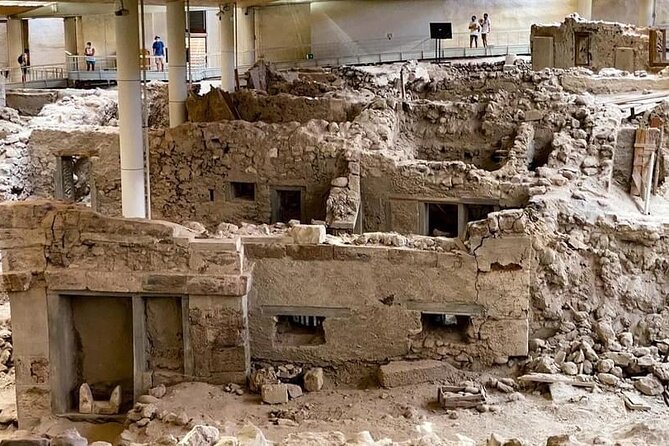
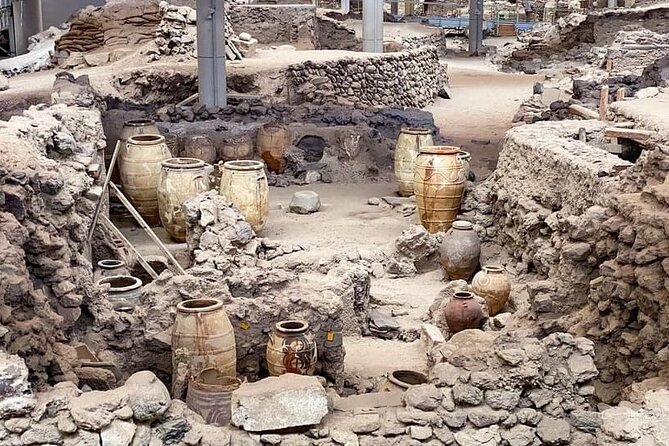
Akrotiri is not a ruin made up only of broken columns and scattered stones. You walk through the remains of a real town, where houses once had multiple levels, painted rooms, storage areas, kitchens, balconies, and systems for moving water and waste.
That makes it a strong choice for children. Instead of asking a five-year-old to admire walls without context, the guide gives young participants small tasks. They spot clues, solve simple missions, and work out how people used the buildings. The reward at the end gives the visit a clear finish.
For you, the treasure hunt does not replace the archaeological explanation. The guide also discusses the town’s architecture, technology, daily routines, art, and destruction by a volcanic eruption. Parents can follow the children’s activity while receiving a more detailed account of what they are seeing.
The approach works best when your family enjoys learning through play. If your children prefer a fast look at ruins with no questions or activities, the structure may feel less important. For ages 5 to 12, though, the game gives them a reason to look closely.
More Family and Kids Games in Greece
- Greek Mythology Treasure Hunt for Kids – Athens Private Tour
★ 5.0 · 77 reviews - Athens: Family Mythology Treasure Hunt and Tour
★ 4.8 · 42 reviews - Athens: Percy Family Treasure Hunt & Tour
★ 4.8 · 19 reviews
Walking the main street through a buried town
The central stop is the Akrotiri Archaeological Site, where your private visit lasts about 1 hour and 20 minutes according to the detailed activity plan. The broader experience is described elsewhere as roughly 1 hour 40 minutes to 2 hours 10 minutes, while the tour highlights refer to a private three-hour walking tour. Treat the timing as flexible rather than fixed, with the site visit forming the main part and transportation adding to the total.
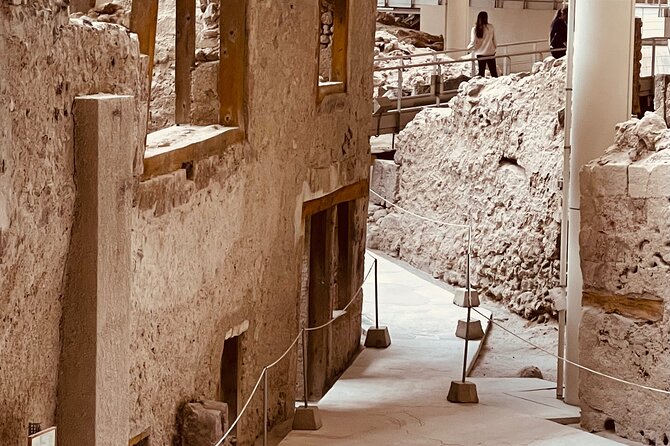
Inside, you follow the excavated streets and pass the remains of shops and homes. You can see how the town was arranged, not just individual objects in glass cases. That matters because the scale and planning of Akrotiri become clearer when you move through its streets.
The volcanic ash helped preserve details that would normally disappear. Pottery can still show original drawings, and parts of rooms reveal how people organized domestic life. Look for evidence of kitchens, balconies, furnishings, and household spaces as the guide explains how each part may have been used.
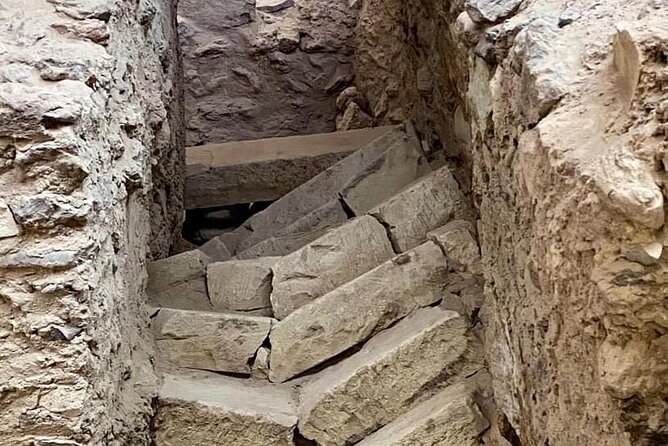
One especially useful subject is water. The town’s residents had systems that helped them obtain and manage water, and the guide explains how the community adapted to that need. You also hear about drainage and sewage systems, a reminder that this was not a primitive settlement thrown together without planning.
You will not simply be told that Akrotiri was advanced. You can see that idea in the remains themselves. Streets, buildings, sanitation, water management, and decoration all help build the picture.
Frescoes and pottery provide the human details
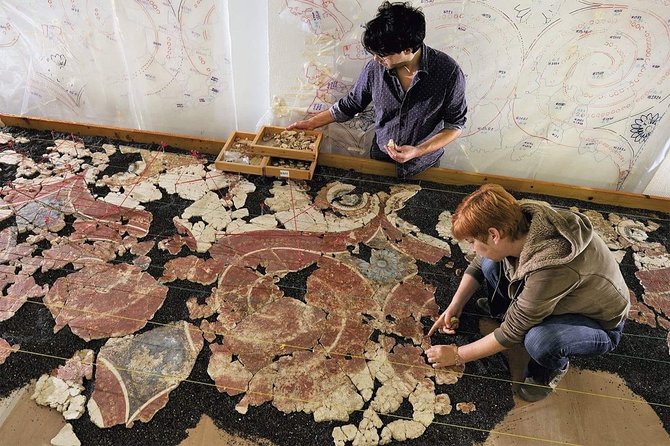
Large buildings can tell you about engineering, but pottery and painted walls bring the people back into the story. The site includes objects and preserved art that help explain what residents valued, how they decorated their homes, and what kind of daily life took place behind those walls.
The original drawings on pottery are a particular point of interest. They are easy to overlook if you walk through alone, especially since the site has only a limited number of explanatory signs. Your guide can point out details that would otherwise blend into the larger excavation.
The same is true of the frescoes. You may see references to rooms that once had colorful wall paintings, even when the original art is displayed elsewhere or preserved in a more controlled setting. Ask your guide to connect the painted fragments and archaeological remains with the broader story of the town.
Georgia, one of the guides associated with this experience, has used pictures on an iPad to show extra material during the explanation. That can help you picture how certain rooms, artworks, or objects fit together. The assigned guide may vary, and Mariana has also led this experience, so do not assume a specific person unless the provider confirms it.
A private guide changes how much you notice
You can walk through an archaeological site on your own, but Akrotiri rewards explanation. The signs do not provide a full account of every room, building system, or object. A guide helps connect separate details into one story.
The strongest part of the guiding style is the chance to ask questions as you go. A private group gives you more freedom than a large party, and the guide can focus on your family’s interests. If your children become fascinated by water systems, pottery, or wall art, you can keep that thread going instead of being pulled along by a fixed group schedule.
There is one practical caution. The guide may keep the group moving through the site, and some families may want longer pauses than the standard route allows. One past experience felt too fast because the guide continued past certain sights. The sensible fix is simple: ask to stop, and ask questions as soon as they occur. A private tour offers flexibility, but you need to use it.
The guide’s role is also especially important for adults. While children search for clues, you can ask about architecture, household life, technology, and the eruption that buried the town. The best version of this experience gives both age groups something to do.
More Treasure Hunts in Greece
- The Acropolis Treasure Hunt: Licensed Guide + Interactive Puzzles
★ 5.0 · 60 reviews - Athens Urban Treasure Hunt w Food Stop
★ 5.0 · 16 reviews - Athens Family Mythology Treasure Hunt and Tour w Food Stop
★ 5.0 · 15 reviews - Treasure Hunt Around Acropolis— Private Group
★ 5.0 · 10 reviews
Why the volcanic eruption matters here
Akrotiri’s appeal depends heavily on its unusual preservation. The town was buried by volcanic ash around 1450 BC, leaving behind a record of homes, streets, objects, and artwork that would have been lost or badly damaged in an ordinary abandoned settlement.
The eruption is not just a dramatic ending added to the tour. It explains why you can still study so many details of Bronze Age life. The ash covered rooms and objects, while the lack of human remains at the site helps distinguish Akrotiri from a disaster scene filled with casualties. The supplied information does not provide further details about evacuation or the exact sequence of events, so your guide is the right person to ask for the version presented during your visit.
For children, this part of the story can be memorable, but it should be handled as archaeology rather than a scary tale. The treasure hunt keeps the emphasis on discovery, while the guide explains how the eruption preserved the town for thousands of years.
Pickup saves effort, but confirm the meeting place
Hotel pickup and drop-off are included as an available feature, and the provider asks where you prefer to be collected. You can request pickup from a hotel, port, or airport, but you need to give that information when arranging the tour.
This is useful on Santorini, where reaching the southern part of the island can add planning to your day. A professional driver has handled pickup and return for some private groups, including a scenic route from Oia to Akrotiri. The driver is not necessarily the guide, so expect the transport portion and the archaeological visit to be separate parts of the experience.
Confirm your pickup point and timing after booking. The booking confirmation is issued within 48 hours, subject to availability. If you are arriving by cruise ship, be especially clear about the port meeting details, since the tour information does not provide a fixed port procedure.
The site is near public transportation, but included pickup is the easier choice for families carrying bags, managing tired children, or working around a busy Santorini schedule.
What the $421.03 group price really buys
The listed price is $421.03 for a private group of up to four people. Admission is not included, and the archaeological site charges €20 per person. For four people, that adds €80, before any food or drinks.
At first glance, this is a costly way to spend roughly two hours. The value improves if you have four people sharing the cost, since the price is per group rather than per person. It also buys privacy, hotel transport, a licensed tourist guide, and an activity designed around your own family rather than a general adult group.
I would not choose this solely for transportation. You can find other ways to reach Akrotiri. The reason to pay more is the combination of a child-focused activity and personal explanation. A self-guided visit may cost less, but you will need to supply the storytelling and keep younger children engaged yourself.
The price also makes the tour less appealing for a couple without children. Adults who care deeply about archaeology may prefer a longer, more specialized visit, while families with children in the intended age range gain the most from the treasure hunt.
How to get the best visit from your guide
Before the tour begins, tell the guide what interests your family. Mention if your children are especially curious about art, homes, water, food preparation, or the volcanic eruption. That gives the guide useful direction within the private format.
During the walk, do not wait until the end to ask questions. If you want to stop at a room, pottery display, or wall painting, say so clearly. Some past families felt the presentation moved too quickly, while others valued the efficient pace and found the guide responsive to questions.
A guide may use visual material on an iPad to add context. Ask when an image relates to something you are looking at, rather than treating the visit as a speech you must simply follow. Your questions can also help your children stay involved.
The site visit is mainly on foot, and a moderate level of physical fitness is advised. No specific health restrictions are listed. Service animals are allowed. Wear practical shoes and plan for the fact that children may tire before adults do, especially if the overall outing includes transport and time elsewhere on Santorini.
Who will enjoy this Akrotiri experience most
This is a good fit for families with children ages 5 to 12 who enjoy puzzles, clues, and short missions. It also suits parents who want to learn about the site without asking children to stand quietly through a long adult lecture.
The private setup is helpful for families with different attention spans. You can move at your own rhythm, ask for clarification, and spend more time on subjects that catch your children’s interest. Pickup and drop-off make the day simpler, particularly if you are staying in Oia or need transport from another listed location.
It is less suitable if you want a long, slow archaeological study. The detailed site visit is about 1 hour and 20 minutes, and the overall duration varies in the supplied information. If you want to examine every room at length, discuss that expectation before starting.
It may also disappoint if you expect entrance tickets, lunch, or drinks to be part of the price. None of those are included. You pay the €20 site admission separately for each person.
Should you book the Akrotiri family treasure hunt?
Book it if your children are between 5 and 12, you want a private guide, and you prefer learning through activity rather than a standard walking talk. The strongest reasons are the child-friendly missions, the chance to see real homes and town systems, and the guide’s ability to explain details that signs may not cover.
I would also book it if transport matters and you want hotel pickup and return handled for you. The group price makes more sense when shared by four people, though you should add the separate entrance fee before comparing it with other options.
Think twice if you need an exact three-hour program, dislike a brisk pace, or want a specialist-level archaeological lecture. Confirm the duration, pickup point, and guide expectations in advance. Then use the private format actively by asking for pauses and explanations.
For the right family, this is more than a walk around old stones. It gives children a reason to look, adults a reason to ask questions, and the whole group a clearer sense of how people lived before the eruption changed Akrotiri forever.
FAQ
How much does the Akrotiri family treasure hunt cost?
The price is $421.03 per private group of up to four people. Admission to the Akrotiri Archaeological Site is separate and costs €20 per person.
Is the entrance ticket included?
No. Each participant must pay the €20 Akrotiri archaeological site entrance fee separately.
How long does the experience last?
The listed duration is approximately 1 hour 40 minutes to 2 hours 10 minutes. The detailed site visit is described as about 1 hour 20 minutes, while other tour details describe it as a private three-hour walking tour, so confirm the exact timing when booking.
What ages suit the treasure hunt?
The activity is designed mainly for children ages 5 to 12 and their parents.
Is hotel pickup available?
Yes. Pickup and drop-off can be arranged from a hotel, port, or airport. You need to tell the provider where you prefer to be picked up.
Is this a private tour?
Yes. Only your group participates, with a licensed tourist guide.
Is the tour offered in English?
Yes. The experience is offered in English.
Can I cancel for a full refund?
Yes, if you cancel at least 24 hours before the experience start time. Cancellations or changes made less than 24 hours before the start are not accepted for a refund.
Just added around Greece
- Thessaloniki Private Treasure Hunt & Tour w Food Stops★ 5.0 · 3 reviews
- Kos Scavenger Hunt and Highlights Self Guided Audio Tour★ 4.5 · 17 reviews
- The Hunt of the Olympian Gods, scavenger hunt for families, prive★ 5.0 · 3 reviews
- Knossos Palace Self-Guided Treasure Hunt & Tour★ 4.0 · 6 reviews
- True Love in Chania: Self-Guided Romantic Puzzle Walk★ 4.5 · 3 reviews
- Unlock Heraklion – Urban Escape Game Adventure★ 5.0 · 3 reviews
- Heraklion Family Treasure Hunt with Food Stop★ 5.0 · 5 reviews
- Chania Scavenger Hunt and Highlights Self Guided Audio Tour★ 4.5 · 2 reviews
Treasure Hunts, compared.


St. Augustine: Treasure Hunt Cruise with Onboard Show
Read our review →

Fun, Flexible Treasure Hunt Around Manchester with Cryptic Clues & Hidden Gems
Read our review →
Fun, Flexible Treasure Hunt Around York with Cryptic Clues & Hidden Gems
Read our review →
Fun, Flexible Treasure Hunt Around Bath with Cryptic Clues & Hidden Gems
Read our review →York Treasure Hunt Adventure: The Mystery of The Gunpowder Snitch
Read our review →Browse the lists this tour appears in