

Reviewed · NETHERLANDS
e-Scavenger hunt Deventer: Explore the city at your own pace
Deventer’s old center becomes your playing field in this self-guided city hunt, where your phone leads you from churches and squares to the synagogue and Walstraat. You solve riddles, complete assignments, and try to beat your own group’s score rather than follow a guide carrying an umbrella.
I like the freedom to start any time and the fact that one price covers up to six people. I also like the built-in reason to look closely at places you might otherwise pass by. The main drawback is simple: you need your own smartphone and mobile data, and the quality of the outing depends on how much your group enjoys app-based games.
Key points before you book
- Up to six people share one group price: This works well for families or friends who want a private activity without paying per person.
- Twelve Deventer stops create the route: The trail includes the Speelgoedmuseum, Stadhuis, Broederenkerk, Lebuinuskerk, De Brink, Bergkerk, Walstraat, and more.
- No fixed start time: You can begin any time from noon to midnight, every day, and pause or stop when it suits you.
- Scores add a competitive edge: Riddles and assignments turn sightseeing into a team challenge with a leaderboard.
- English and other languages are available: The trail is offered in English, German, French, Dutch, Spanish, Italian, and more.
- Bring the practical essentials: Your smartphone and data are not included, and the activity starts and ends at Kleine Poot 7.
A city walk with a game built in

The Qula Deventer City Trail is not a guided tour with a set speech and timed stops. It is a private game for your group, delivered through an Android or iPhone. After booking, you receive an email with instructions. Once you reach the starting point, you open the trail and begin.
That format changes the pace. You are not racing behind a guide, and you do not need to arrive at 10:00 sharp. You can fit the activity around lunch, a museum visit, shopping, or another Deventer plan. The stated playing time is roughly two hours, while the tour summary gives an approximate duration of three hours. I would allow two to three hours, especially if you stop for photos, pause for a meal, or take time to read the clues.
The game asks you to solve riddles and complete assignments at or near the sights. The exact nature of every task is not specified, so you should expect a mix of observation, teamwork, and phone interaction rather than a traditional history lecture. The score matters if your group likes competition. If not, you can still use the questions as a prompt to notice details around you.
This is a good distinction to make before paying. The experience teaches you about Deventer while you move through its center, but it does so through a game. I would not choose it as my only source of detailed historical explanation. I would choose it when I want a flexible way to get oriented and keep a family or group engaged.
More Scavenger Hunts in the Netherlands
- e-Scavenger hunt Maastricht: Explore the city at your own pace
★ 4.5 · 110 reviews - e-Scavenger hunt Middelburg: Explore the city at your own pace
★ 4.5 · 55 reviews - e-Scavenger hunt Den Bosch: Explore the city at your own pace
★ 4.5 · 37 reviews
Why the group price can be good value
The listed price is $37.21 per group of two to six people. For six people, that works out to a little over $6 each. For two people, the per-person cost is higher, but you still get a private activity rather than joining a larger party.
The value depends on your group size and temperament. A family of four to six can get a substantial city activity for one group fee. Friends who enjoy points, riddles, and friendly competition may find the game more memorable than a plain self-guided walk. You also avoid the cost and scheduling limits of a private human guide.
The tradeoff is that the price does not include a phone or mobile data. You need at least one compatible Android or iPhone with a working data connection. If the battery is low, charge it before heading to Kleine Poot 7. This is a small practical point, but it matters more here than on a normal walk because the phone is the tour.
The activity has a rating of 4.1 from 34 reviews, which suggests a generally positive but not flawless response. One harsh response objected to the group format, saying that the claim of six people was a money-making setup. The operator replied that six people can play together. The useful point for you is to understand the pricing clearly: this is one booking for a team of up to six, not six separate guided experiences.
Starting at the Speelgoedmuseum
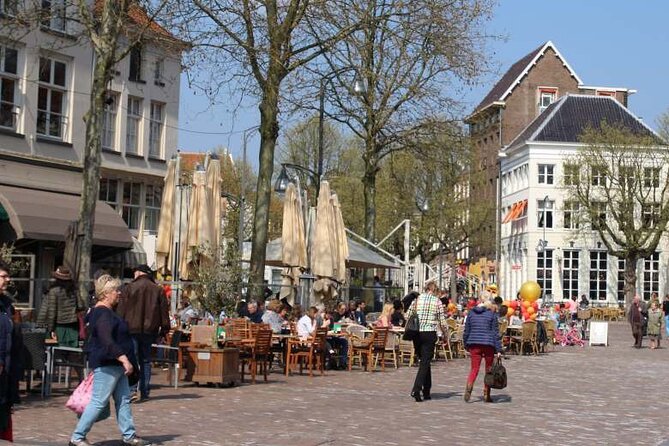
The route begins at Speelgoedmuseum Deventer, the Toy Museum. This gives the hunt a playful opening and makes the starting point easy to recognize by name. From here, your phone takes over, so read the instructions before you set off rather than trying to work out the system while your group waits.
A museum stop can tempt you to go inside, but the supplied details do not say that admission is included or that the game includes an interior visit. Treat the museum as a route landmark unless the app tells you otherwise. If you want to visit it properly, check separately how that fits with your playing time.
Deventer and the Stadhuis
The next stops are listed as Deventer and Stadhuis van Deventer. The broad Deventer stop likely helps connect the game to the city itself, while the Stadhuis gives you a clear civic landmark to examine. You may find that the assignment asks you to look at features you would miss on a fast walk.
This is where the trail’s design earns its keep. A standard route tells you where to go. A riddle asks you to pay attention. I like that difference for first-time visitors who want a light introduction without committing to a formal tour.
The town hall stop also gives your group a natural chance to pause and agree on an answer. With six people, divide the work sensibly. One person can read the clue, another can check the surroundings, and someone else can handle the phone. The game is private, so you can take your time without worrying about holding up another party.
Same streets, a different set of clues:
- Amsterdam Treasure Hunt: The Mystery of a Secret Sender
★ 5.0 · 149 reviews - Amsterdam: Treasure Hunt Walking Tour “A Secret Sender”
★ 4.7 · 71 reviews - Utrecht Old Town: Medieval Monster Hunt & Walking Tour
★ 4.0 · 62 reviews - Discover Utrecht with a self-guided Outside Escape city game tour
★ 4.5 · 51 reviews
Broederenkerk and the Lebuinuskerk
The trail continues to Broederenkerk, then Lebuinuskerk. Two churches in succession give this part of the route a strong architectural and historical feel, even though the experience presents its information through the app rather than a live guide.
Do not rush these stops simply to chase a high score. Churches reward a slower look, and your group may need a moment to read the assignment and work out what the game wants you to notice. The details provided do not promise entry, interior access, or opening times, so you should not assume that either church will be open when you arrive.
The Lebuinus section also includes the Toren Grote of Lebuinuskerk as its own stop. That separation suggests the tower has a distinct role in the route. You can expect the trail to direct your attention to the church and then the tower as separate landmarks, rather than treating them as one quick waypoint.
De Brink, the city’s natural pause point
De Brink is another major stop. A central square is a useful place for a city game because it gives your group room to gather, read the next clue, and compare answers. If your party includes children, this sort of open stop can help break up the more focused church and civic landmarks.
The game has no time limit, so you do not have to solve everything in one continuous push. You can pause at De Brink for food or a rest, then return to the trail. That flexibility is one of the strongest reasons to choose this format over an appointment-based tour.
The app may assign points for speed, accuracy, or completed tasks, but the supplied information only confirms riddles, assignments, and a leaderboard. I would treat the score as a fun extra, not as a promise of a detailed competitive system.
Bergkerk and the Wilhelminafontein

Bergkerk follows De Brink, adding another church to the route. By this stage, you will have seen several religious landmarks, but the game’s questions can give each one a separate purpose. If your group enjoys noticing differences between buildings, this section may hold your attention better than a simple list of names.
Wilhelminafontein is the next named stop. A fountain offers a change of scale and setting after the churches. It also makes a practical meeting point if your group spreads out while solving an assignment. The trail’s stop list gives you a clear sense of the route’s variety: museums, civic buildings, churches, a square, a fountain, streets, and religious heritage all appear in one outing.
Again, do not assume that every stop includes an admission ticket or an extended explanation. The included item is the city trail for a team of up to six. Entrance fees, if any are needed, are not listed as included.
Walstraat, De Proosdij, and the Synagoge

Walstraat Deventer brings the route into a street setting. This is an important part of the experience because a city is not only its major monuments. A game that directs you along a street can help you pay attention to the ordinary urban details between the headline sights.
De Proosdij follows, then the Synagoge. These final stops give the route a wider historical range than a walk limited to the best-known churches. The synagogue is especially useful as a reminder that Deventer’s story includes different religious and civic communities. The supplied details do not give a date, access arrangement, or interior program, so look to the app for the task and treat the building as a marked stop unless told otherwise.
Ending at the synagogue also means the final part of the game is not just a return to the start. The activity itself ends back at the meeting point, so after completing the last assignment you follow the route back to Kleine Poot 7. Factor that return into your time, especially if you are arranging another booking.
How the phone format affects your day
The app is both the strength and the weakness of this experience. It gives you instructions, keeps the group moving, and turns the route into a shared challenge. It also means the experience depends on your device, battery, data connection, and willingness to look at a screen while exploring.
I suggest downloading or reviewing the instructions before you arrive, checking that your phone has enough power, and making sure your group knows who will carry the device. The tour is designed for Android and iPhone. Smartphone and data are not provided.
There is no fixed start time or reservation slot to meet. The trail is available 24 hours a day, every day, within the stated operating period, and the opening-hours information lists Monday through Sunday from midnight to midnight. In practical terms, you can choose your own day and time. Still, daylight may make it easier to see buildings and complete observation tasks, so I would choose a comfortable daytime start unless your booking instructions say otherwise.
The activity is offered in English, German, French, Dutch, Spanish, Italian, and more. That makes it easier for mixed-language groups to play together, though the exact language choices should be checked in your booking instructions.
Who will enjoy this Deventer outing
I would recommend the trail most strongly to families, couples, and friend groups who like a little competition. A group of six gets the best financial value, and children or teenagers may respond better to points and assignments than to a long spoken explanation.
It also suits visitors who dislike rigid schedules. You can start after lunch, pause when you want, or stop before finishing and continue later because there is no time limit. That is useful in Deventer, where you may want to combine the trail with museums, food, or other city plans.
I would be more cautious if you want a detailed, expert-led account of Deventer’s past. There is no named guide, and the experience is delivered through your phone. It also may not suit a group that dislikes screen-based activities or does not want to compete.
The activity is private, and only your group participates. Service animals are allowed. It is described as suitable for most people and user-friendly for people with hearing impairments. The route’s accessibility for every mobility need is not specified, so contact the provider if you need details beyond those points.
Booking, cancellation, and the final call
You can cancel for a full refund if you do so at least 24 hours before the experience start time. Changes or cancellations inside that window are not accepted for a refund, and the cutoff uses local Dutch time.
Should you book it? Yes, if you want an affordable, flexible group game that introduces Deventer through its main sights. The best case is a family or friend group of four to six, with one charged phone per team and a shared appetite for riddles.
Skip it if you want a live guide, guaranteed interior visits, or a carefully paced historical lecture. For everyone else, the combination of twelve stops, no fixed start, several language options, and one group price makes this a practical way to explore Deventer without surrendering your day to a timetable.
FAQ
How many people can play the Deventer City Trail?
One private team of up to six people can play together. The listed price is per group of two to six people.
How long does the experience take?
The trail is described as taking about two hours, while the overall tour duration is listed as approximately three hours. Allow two to three hours, depending on pauses, photos, and how quickly your group solves the assignments.
Is there a fixed starting time?
No. You choose your own day and start time. The trail is available 24 hours a day, every day, during the stated operating period.
Where does the trail start?
The meeting point is Kleine Poot 7, 7411 PE Deventer, Netherlands.
Where does the activity end?
The activity ends back at the meeting point.
What do I need to bring?
You need an Android phone or iPhone and mobile data. A smartphone and data are not included.
Is the activity available in English?
Yes. English is available, along with German, French, Dutch, Spanish, Italian, and more.
What sights are included?
Stops include Speelgoedmuseum Deventer, Deventer, Stadhuis van Deventer, Broederenkerk, Lebuinuskerk, the tower of the Grote or Lebuinuskerk, De Brink, Bergkerk, Wilhelminafontein, Walstraat Deventer, De Proosdij, and the Synagoge.
Can I cancel for a refund?
Yes, if you cancel at least 24 hours before the experience start time. Cancellations made less than 24 hours in advance are not refunded.
Just added around the Netherlands
- Amsterdam: “Operation 45 ” Treasure Hunt Walking Tour★ 4.5 · 6 reviews
- Discover The Hague’s scenic courtyards in an Outside Escape game!★ 4.0 · 16 reviews
- Roermond Self Guided Sherlock Holmes Murder Mystery Game★ 4.5 · 3 reviews
- Groningen Self Guided Sherlock Holmes Murder Mystery Game★ 3.5 · 3 reviews
- Escape Room – l’Architecte★ 4.5 · 13 reviews
- Discover Breda with a self-guided Outside Escape city game tour!★ 5.0 · 16 reviews
- Exciting Murder Mystery – Interactive city walk in Arnhem★ 4.5 · 3 reviews
- Exciting Murder Mystery – Interactive city walk in Groningen★ 4.5 · 8 reviews
Scavenger Hunts, compared.


Amazing Cozumel Race: Small-Group Tour and Scavenger Hunt
Read our review →
An Epic Scavenger Hunt: New York City Central Park Adventure
Read our review →


Escaping and spying on the Berlin Wall Scavenger hunt
Read our review →
Browse the lists this tour appears in