

Reviewed · BRUSSELS
e-Scavenger hunt Brussels: Explore the city at your own pace
Brussels becomes a playful puzzle on this self-guided phone quest. You follow a GPS map from Putterie through central sights, solving riddles and assignments as you go, with no guide or fixed departure time. I like the complete flexibility and the chance to compete for a top score with your own group. The price is also appealing: $37.29 covers up to six people, not each person.
I also like that the route includes major sights such as Grand Place, Manneken Pis, the Royal Palace, and the Galeries Royales Saint-Hubert. The main catch is that this is a game first, sightseeing lesson second. Some challenges use music, photos, or general observation rather than explaining the landmark in front of you, and the map may feel awkward if your phone data is weak.
Key points before you book

- A private game for two to six people: One booking covers your whole group, making the cost especially reasonable for families and friends.
- Start any time, 24 hours a day: There is no fixed departure slot, and you can pause or stop whenever you like.
- Seventeen Brussels locations: The route links central sights with places farther afield, including the Horta Museum and the Royal Greenhouses of Laeken.
- Expect riddles and assignments, not a guided lecture: The activity is designed around play, scoring, photos, and music.
- Bring your own phone and mobile data: A smartphone is not included, and the GPS-led map is central to the experience.
- Free cancellation until 24 hours before: Cancellations inside the final 24 hours are not refunded.
A Brussels sightseeing game, not a traditional tour
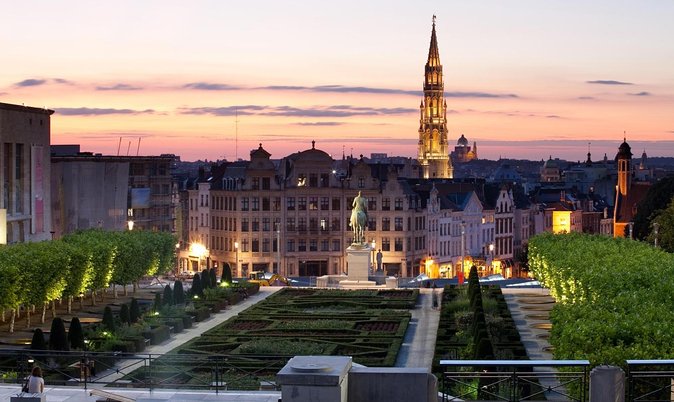
This experience works best when you want to see Brussels while doing something together. You receive instructions by email, go to the starting point at Putterie 1, and begin the game on an Android phone or iPhone. There is no guide waiting for you, no group departure, and no need to match your day to a timetable.
The game sends you from one location to the next. At each stop, you handle a question, riddle, photo task, or other assignment. The GPS map is intended to keep you moving in the right direction, while your group tries to earn a strong score.
That format is useful for families with different attention spans. You can stop for food, take a break in a square, or pause the activity when a museum or shop catches your eye. You are not tied to a guide’s pace.
The trade-off is clear. If you want a person to explain Belgian politics, architecture, royal traditions, or the background of each church and square, this will feel thin. One particularly important example is a music challenge connected with Jacques Brel and a Brussels square. That may be fun if you know his work, but it does not replace a proper explanation of the place.
The product is available in English, German, French, Dutch, Spanish, Italian, and other languages. Check that your preferred language is available before starting.
More Scavenger Hunts in Belgium
- e-Scavenger hunt Antwerp: Explore the city at your own pace
★ 4.5 · 67 reviews - e-Scavenger hunt Bruges: Explore the city at your own pace
★ 4.5 · 58 reviews - Bruges Scavenger Hunt and Highlights Self Guided Audio Tour
★ 4.0 · 54 reviews
Starting at Putterie and Brussels Central Station
The starting point at Putterie 1 puts you near Brussels Central Station, a practical location in the city center. The first section brings you through the area around Brussels Central Station, so you can begin with a major transport landmark rather than a remote meeting point.
From here, the game continues to Parc de Bruxelles, also called Warandepark. This formal green space lies beside the Royal Palace and offers a change from the dense streets around the center. A park is also a sensible place for a game: you have room to stop, read the prompt, and compare answers without blocking a narrow pavement.
The route then reaches the Royal Palace, or Palais Royal. The exterior is the main point here, since the activity does not promise an interior visit. You may get a question tied to what you can see around the building, but do not expect a palace tour or detailed royal commentary.
These opening stops help you get your bearings. Still, you should keep your phone charged and your map open. The activity depends on finding the correct places through the app, and the map is not a substitute for a full Brussels navigation app.
From the Town Hall to Manneken Pis
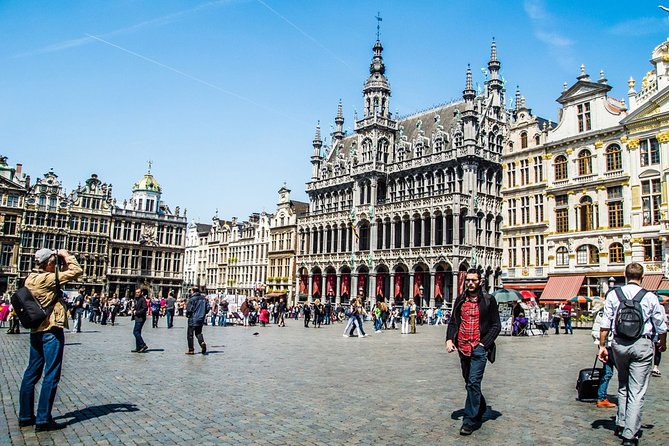
Next comes Brussels Town Hall, or Hotel de Ville de Bruxelles, on the Grand Place. This is one of the most rewarding sections for a first visit because the buildings are close together and the setting is easy to recognize.
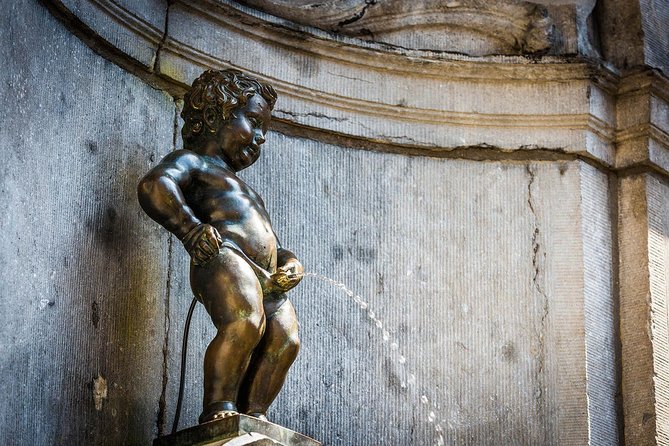
The game also sends you to Manneken Pis, Brussels’ famously small statue. It is a quick stop, and the contrast between the statue’s modest size and its international fame is part of the fun. A riddle here can work well for a group because everyone can inspect the setting and compare answers.
The route then includes St. Michael and St. Gudula Cathedral. This large Gothic church is one of the city’s major landmarks, and its exterior gives the activity a more serious architectural counterpoint to Manneken Pis. If you want to enter, take photographs, or sit quietly for a moment, the flexible format lets you pause.
Remember that the game does not guarantee a long explanation at any of these places. You are being sent to the landmark so you can complete a task. If your group wants more context, plan to use a separate guidebook or information source alongside the activity.
Grand Place, guild houses, and the city’s grandest streets
Grand Place is the route’s natural centerpiece. The square is surrounded by ornate guild houses and the Town Hall, and it gives you the strongest single sense of Brussels’ historic center.
The nearby guild houses add detail to the stop. Look up at the facades, compare the decorative symbols, and use the game as a reason to slow down instead of simply crossing the square. The exact challenge may ask you to identify an image or answer a question rather than read a long account of the buildings.
The Quartier de L’Ilot Sacre brings you into the narrow central quarter around Grand Place. This area is full of pedestrian lanes and busy sightseeing traffic. The self-guided setup helps you avoid joining a large group, but you still need to watch your phone and your surroundings on crowded streets.
Les Galeries Royales Saint-Hubert offers a different kind of Brussels setting. This elegant covered shopping arcade is more polished than the old lanes around it, with glass overhead and grand architectural details. It is a good place for a photo-based task, though a crowded arcade can make phone navigation less comfortable.
The Brussels Vintage Market is another change of mood. It brings a more casual, market-style stop into a route otherwise heavy on official buildings, churches, and major monuments. Opening conditions can vary, so treat it as a listed location rather than a guaranteed shopping opportunity at every hour.
Same streets, a different set of clues:
- Escape Hunt Brussels, Escape Game
★ 5.0 · 103 reviews - e-Scavenger hunt Ghent: Explore the city at your own pace
★ 4.5 · 41 reviews - Beer Tasting and Scavenger Hunt in Brussels – About 3 Hours
★ 4.5 · 35 reviews - e-Scavenger hunt Mechelen: Explore the city at your own pace
★ 4.0 · 34 reviews
Laeken and the longer reach of the route
One of the more important practical points is the inclusion of the Royal Greenhouses of Laeken, or Koninklijke Serres Van Laken. This location is not in the same compact cluster as Grand Place, Manneken Pis, and the cathedral.
The route may therefore feel less like a short walk through the old center and more like a broader Brussels challenge. The supplied timing says the trail can guide you along the best places within two hours, while the overall experience is described as approximately three hours. The difference likely reflects how quickly your group solves tasks, pauses, takes photos, and moves between locations.
Do not assume that every stop is a long visit. Some are likely points for completing a prompt. If your group wants to spend time at the greenhouses, museum, or market, allow extra time beyond the basic game.
The Laeken stop is useful for people who want the route to reach beyond the standard central highlights. It is less useful if you are looking for a tightly packed walking loop with every stop a few minutes apart. Before starting, make sure your group understands that the full set of locations may require more planning than a simple central-city stroll.
Sablon, Horta, and Brussels after the postcard sights
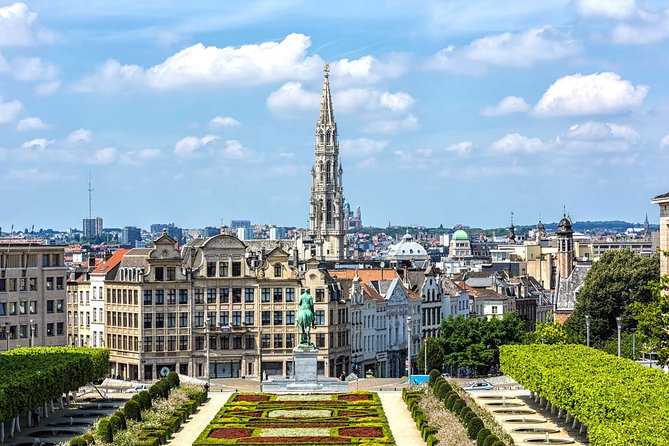
The route continues to Notre Dame des Victoires au Sablon, a notable church in the Sablon district. This section shifts you away from the Grand Place area and toward one of Brussels’ more elegant central quarters.
The Horta Museum adds an architectural angle. It connects the game with Victor Horta and Brussels’ Art Nouveau tradition. Again, the activity does not promise museum admission or a guided visit, so check your schedule if you want to go inside. The game can point you toward the area, but it is not a replacement for the museum itself.
La Mort Subite is included as a named stop. This is a well-known Brussels café and beer venue, and it gives the route a social, local flavor after so many monuments. You do not need to turn every stop into a paid visit, but the flexible timing lets you pause for a drink if it suits your group.
The Comic Art Museum follows naturally for anyone interested in Belgium’s famous comic culture. It adds another side of Brussels beyond royal buildings and medieval squares. As with the Horta Museum, the route identifies the place, but the activity information does not include admission or an inside tour.
Rue Neuve brings you to one of the city’s principal shopping streets. It is a practical contrast to the old center and the formal landmarks. The final portion through the central districts gives the game a more everyday urban setting rather than ending only at postcard locations.
How the challenges affect the experience
The biggest question is simple: do you want information, or do you want interaction?
The challenges can make a familiar sightseeing route more social. You might compare answers, argue over a photo, identify a singer, or try to beat another person in your group. The competition gives children and teenagers a reason to keep moving, while adults can enjoy the odd turns the game takes.
But some tasks may feel only loosely connected to the place where you are standing. A music clip or an image that was not taken at the location can be entertaining, yet it may not teach you much about Brussels. One challenge uses Jacques Brel, a major Belgian singer, and connects his music with a square. If you do not know him, the question may seem random rather than revealing.
This explains the mixed fit of the activity. People who enjoy escape-room puzzles, phone games, and friendly competition may find the format lively. People who booked a guided city tour may be disappointed by the limited explanation and by questions that are not always about the monument itself.
The best approach is to treat the game as a framework for exploring. When a prompt takes you to a building you like, pause and look around. Add your own reading or research if you want the cultural background the game does not provide.
Price, timing, and what you need to bring
At $37.29 per group of up to six, the value depends heavily on your group size. Six people pay less than $7 each, which is a strong price for several hours of shared activity. For two people, the per-person cost is higher, but it can still compare well with a private guided experience.
The price does not include a smartphone or data. You need an Android phone or iPhone, and you should have a reliable mobile connection before you begin. The activity is GPS-led, so poor connectivity or a low battery could make the route frustrating.
There is no fixed starting time. The stated opening window runs every day from midnight to 11:59 p.m., and the trail is available 24/7. That gives you room to fit it around a museum visit, meal, or train arrival.
The activity is described as taking about three hours, while the game instructions refer to completing the trail within two hours. Treat two hours as a brisk playing time and three hours as a more comfortable estimate, especially if you stop at sights or pause for refreshments.
You can cancel for a full refund at least 24 hours before the local start time. Changes or cancellations inside the final 24 hours are not refunded.
Who should book this Brussels game?
I would choose this for a family, a group of friends, or a couple who enjoys solving clues together. It is also useful if your schedules are unpredictable, since you can begin when you want and stop when you need to.
The private format matters. Only your own group participates, so you do not need to keep pace with strangers or answer questions in front of a crowd. Service animals are allowed, the route is near public transportation, and most people can participate. It is also described as user-friendly for people with hearing impairments.
I would not choose it as your only source of Brussels history. A traditional walking tour or a good guidebook will give you more explanation about the city’s buildings, politics, art, and traditions. The game works better as a playful layer added to your sightseeing day.
Should you book the Qula Brussels City Trail?
Book it if you value freedom, group competition, and a low group price. The route covers a broad selection of Brussels sights, from Grand Place and Manneken Pis to the Horta Museum, Comic Art Museum, and Laeken. You can start at any hour, play in your own language, and pause whenever the city gives you a reason.
Skip it if you expect a guide-led lesson or carefully researched commentary at every stop. The GPS map and game tasks are the core product, and some prompts may feel disconnected from the landmark.
For the best result, bring a charged phone, confirm your data connection, allow up to three hours, and agree in advance that this is a scavenger hunt rather than a conventional tour. With that expectation, the $37.29 group price can be a practical and entertaining way to see Brussels together.
FAQ
How many people can join one booking?
One booking covers a private group of two to six people.
Is there a fixed starting time?
No. You choose your own day and time, and the trail is available 24 hours a day.
How long does the activity take?
The experience is described as approximately three hours. The trail instructions also say it can guide you through the route within two hours, depending on how quickly you play and how often you stop.
Do I need my own smartphone?
Yes. You need an Android phone or iPhone. A smartphone and mobile data are not included.
Where does the trail start and finish?
It starts at Putterie 1, 1000 Bruxelles, near Brussels Central Station, and ends back at the meeting point.
Which languages are available?
The trail is offered in English, German, French, Dutch, Spanish, Italian, and additional languages.
Can I cancel for a refund?
Yes. You can receive a full refund if you cancel at least 24 hours before the local start time. Cancellations within 24 hours are not refunded.
Just added around Belgium
- Discover Mechelen while playing! Escape game – The alchemist★ 4.5 · 6 reviews
- Discover Leuven while playing! Escape game – The alchemist★ 4.5 · 5 reviews
- Discover Ostend while playing! Escape game – The Walter case★ 4.0 · 16 reviews
- e-Scavenger hunt Kortrijk: Explore the city at your own pace★ 4.5 · 15 reviews
- Discover Ghent with a self-guided Outside Escape city game tour!★ 4.0 · 10 reviews
- Liege Scavenger Hunt and Highlights Self Guided Audio Tour★ 4.0 · 9 reviews
- Discover Dinant while playing! Escape game – The alchemist★ 4.5 · 12 reviews
- Discover Durbuy by playing! Escape game – The alchemist★ 3.5 · 14 reviews
Scavenger Hunts, compared.

Amazing Cozumel Race: Small-Group Tour and Scavenger Hunt
Read our review →
An Epic Scavenger Hunt: New York City Central Park Adventure
Read our review →
Escaping and spying on the Berlin Wall Scavenger hunt
Read our review →
Browse the lists this tour appears in