
Reviewed · MARIENPLATZ
Munich: Scavenger Hunt Self-Guided Tour
Munich’s old town becomes a puzzle board in this self-guided walk. You open numbered envelopes one by one, solve clues, and use the answers to find the next stop, from Karlstor and Stachus to the Frauenkirche, Marienplatz, and Viktualienmarkt. I like the complete freedom to start anytime and the way the game gives families or friends a shared task instead of a standard follow-the-guide walk. The metal box also makes the activity feel like a real game, not just a phone app.
I also like that one box covers a group of up to 10. At $52, that can be fair for a family or small group, especially since you can pause for photos, food, or a coffee. The main caution is the advertised 270 minutes. Some people finish in about 90 minutes, and the clues may feel too easy if you already know Munich. A few stops may also be outdated, so you may need to use the solution card to keep moving.
Key points at a glance
- Sixteen envelopes guide the route: Each contains riddles, directions, facts, and background information.
- The walk begins near Munich’s main station: You continue through Karlstor, Stachus, Neuhauser Straße, and the old town.
- Major sights come built into the game: Expect the Bürgersaal, St. Michael’s Church, Frauenkirche, both town halls, and Viktualienmarkt.
- You set the schedule: Start on any date and at any time after receiving the box, and pause whenever you want.
- The group price can work well: One booking covers up to 10 people, with no guide or entrance fees included.
- The puzzles are best for casual fun: They suit families and team-building groups, but experienced Munich visitors may find them simple.
A city walk that puts the clues first
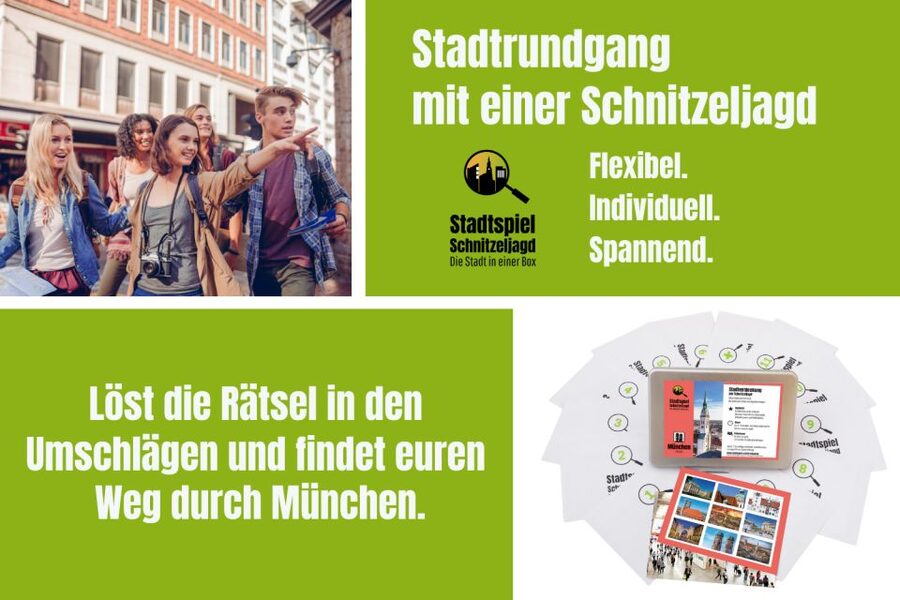
This is not a guided tour with a person explaining each corner as you go. It is a paper-based scavenger hunt, delivered in a metal box, that sends you around Munich’s central sights through a series of numbered envelopes.
That difference matters. You are not tied to a departure time, a guide’s pace, or a fixed pause for the group. If the children need a snack, if you want to take photos at Marienplatz, or if a church is open and worth a look, you can stop the game and continue later.
The route is designed as a sightseeing walk through central Munich. You solve one task, read the directions and information, then open the next envelope when you reach the correct point. An emergency envelope contains the solutions, which is useful if a clue is unclear or a location has changed.
I would treat the 270-minute duration as a generous planning window rather than a promise that you will spend four and a half hours solving puzzles. A brisk group that already knows the center could finish much faster. If you read every fact, stop for photos, look inside churches, and take a break at Viktualienmarkt, the outing can fill more of the afternoon.
More Scavenger Hunts in Germany
- Hamburg: Scavenger Hunt Self-Guided Tour for Children
★ 4.5 · 319 reviews - Dresden: Old Town Self-Guided Scavenger Hunt Tour
★ 4.5 · 151 reviews - Escaping and spying on the Berlin Wall Scavenger hunt
★ 4.5 · 128 reviews
Starting at the main station and Karlstor
The route begins at Munich’s main station, a practical meeting point if you are arriving by train or staying near the center. You need to bring the scavenger hunt box with you. No guide waits at the start, so the box and its instructions are your only introduction.
From there, the walk leads toward Karlstor and Stachus. Karlstor is one of the old city gates, while Stachus is one of Munich’s best-known central squares. This opening section gives you a quick sense of the old town’s scale and puts the game into motion without requiring a formal check-in.
The first clues are likely to feel simple, which can be helpful. You learn how the envelopes work, how the answers connect to the route, and how much information each stop provides. Families can get started without a long explanation, and a group of friends can divide the reading and puzzle-solving between them.
The tradeoff is that the early stages may not challenge experienced players. If you have already walked Munich several times, the answers can feel more like confirmation than discovery. I would choose this activity for its playful structure, not for difficult escape-room puzzles.
Neuhauser Straße, Bürgersaal, and St. Michael’s
The walk continues along Neuhauser Straße, one of the main pedestrian routes into Munich’s old town. The route includes the Bürgersaal and St. Michael’s Church, giving you a chance to pair the puzzle with some of the city’s religious and civic landmarks.
St. Michael’s is especially important to the feel of this section. It is not just another point on a map. A church stop gives the activity a chance to slow down and add context about Munich’s past, provided you take time to look around rather than simply solve the clue and move on.
That is one of the better features of this format. The envelopes include background information and interesting facts, so you get more than bare directions. At the same time, the amount of detail is not always enough for a full sightseeing explanation. Some prompts encourage you to look inside a church or examine a sight, but they may offer only broad guidance.
You should also expect the route to be mainly outdoors. Entrance fees are not included, and the activity does not promise admission to any of the sights. If you want to visit a church or another attraction beyond what the game requires, plan to handle that separately.
Frauenkirche and Munich’s famous skyline

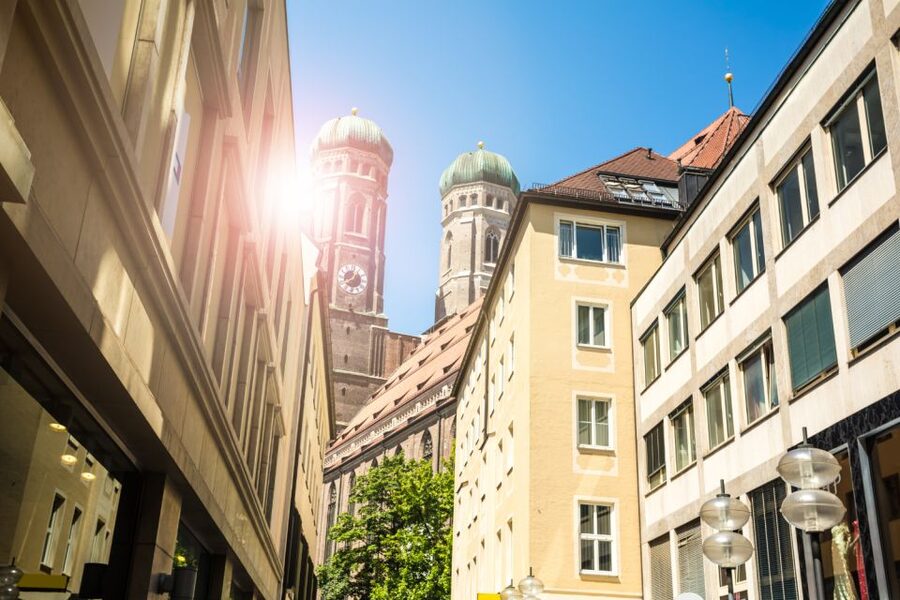
The Frauenkirche is one of Munich’s defining sights, with its twin towers forming the city’s best-known profile. Including it in the route gives the scavenger hunt one of its strongest visual moments.
The envelope system works well here because you can pause without losing your place. Take a photo, study the building, or wait for the group to finish a clue. You do not have to hurry to keep up with anyone else.
The game’s value at this stop depends on what you want from the visit. If you want a lively way to get your family looking closely at the city, the puzzle adds purpose. If you want a detailed account of the church’s architecture, religious role, or past, the supplied information may feel thin.
A few people have found the clues too easy, especially when they already know Munich. That is a fair warning. The activity is closer to a sightseeing game than a serious puzzle challenge. Younger children may enjoy spotting details and helping with answers, while puzzle fans looking for hard logic problems could be underwhelmed.
More Self-Guided Games in Germany
- Berlin: Self-Guided Family and School Class Scavenger Hunt
★ 4.6 · 128 reviews - Düsseldorf: Scavenger Hunt Self-Guided Tour
★ 4.6 · 127 reviews - Leipzig City Centre: Scavenger Hunt Self-Guided Tour
★ 4.4 · 114 reviews - Weimar: Scavenger Hunt Self-Guided Walking Tour
★ 4.3 · 108 reviews
Marienplatz, with both town halls
The route then reaches Marienplatz, the main square in Munich’s old town. You visit both the Altes Rathaus, or Old Town Hall, and the Neues Rathaus, or New Town Hall.
This is the natural center of the experience. Marienplatz gives you a clear place to pause, compare the buildings, and absorb the scale of the square. The New Town Hall is the more visually dramatic building, while the Old Town Hall helps show how Munich’s civic center changed over time.
The scavenger hunt format is useful in a large square because it gives your group a small mission. Rather than simply arriving, taking a quick photo, and moving on, you look for the information needed to answer the next clue.
Do not expect the game to replace a full city-history tour. The envelopes provide background, but the explanations are designed to keep the route moving. If you want long stories about the rulers, architecture, or city government, you will need another source alongside this activity.
One practical point: popular city-center sights can be busy, and a self-guided group needs to keep its materials together. The box is compact enough to carry, but you should avoid opening the next envelope until everyone is ready. That simple habit prevents the route from becoming confusing.
Viktualienmarkt and the best pause in the route
The final major area listed is Viktualienmarkt, Munich’s central food market. This is a smart stop for a walking game because it gives you a natural break after several historic squares and churches.
Food and drinks are not included, so budget separately if you want to eat here. That is not a flaw, but it affects the total cost. You may prefer to browse the stalls, buy a small snack, and then finish the last clue. Since the game can be paused, you are not forced to choose between eating and keeping up with a schedule.
Viktualienmarkt also changes the mood of the route. Earlier stops focus on gates, churches, and town halls. Here, the emphasis is more everyday and local, with food stalls and a market setting. It makes the walk feel less like a checklist of grand buildings.
The route’s distances are generally manageable, according to the supplied information, and the sights are close enough to form a sensible old-town walk. Still, wear comfortable shoes. You are on your feet for much of the experience, and the city-center paving can make a casual stroll feel longer than the map suggests.
How the envelopes and clues work
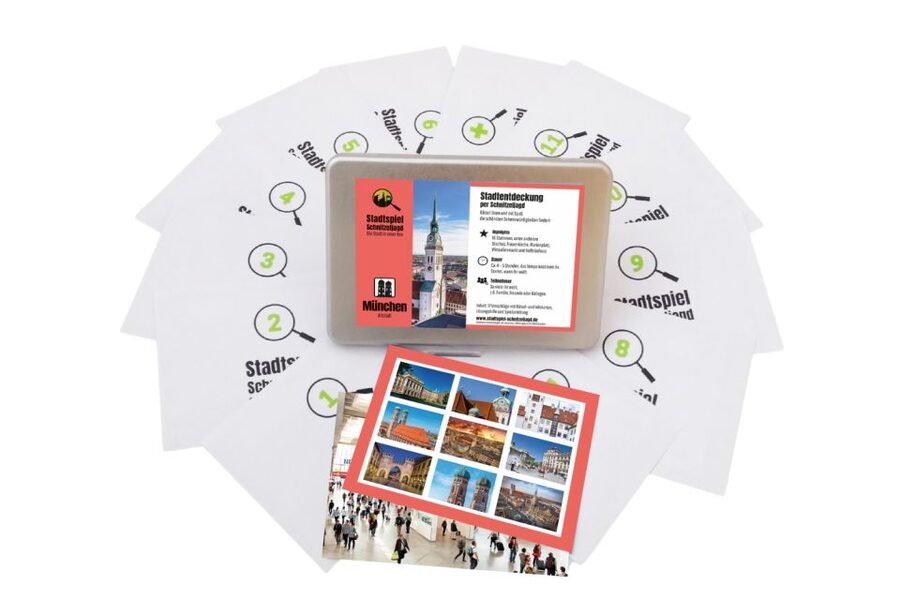
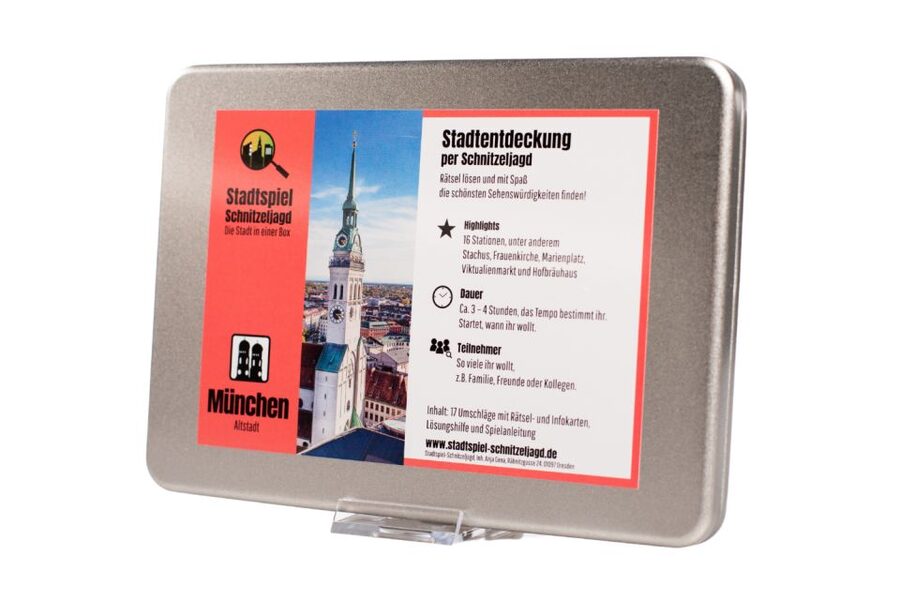
You receive 16 envelopes containing riddles, directions, facts, and information about Munich and Bavaria. The envelopes are numbered, so the intended order is clear. You solve a task, use the answer to identify the next point, and continue through the route.
This setup gives the group a shared job. One person can read the directions, another can study the clue, and someone else can keep track of the box. That division works well for families and small team-building groups. The activity has also been used successfully as a light team exercise, since people must discuss answers and agree on the next move.
The emergency envelope contains all solutions. Use it as a safety net, not as the main way to play. It is particularly useful when a landmark is hard to identify, a clue is unclear, or a place described in the materials has changed.
That last point deserves attention. Some route details may no longer match what you find in the city. A fountain or museum referenced in the game may have changed or disappeared, leaving you dependent on the solution card. This can break the flow, especially if your group wants a polished, up-to-date game.
The materials are attractive, with the metal box adding a tactile quality that a phone-based game lacks. But the paper format also means updates are harder. A digital game can be revised when a location changes. Here, you may occasionally need to work around an old instruction.
Is $52 good value for up to 10 people?
The price is $52 per group of up to 10 people. That makes the calculation very different from a per-person walking tour. A family of four pays about $13 per person, while a full group of 10 pays just over $5 each.
For a larger group, I think the price can be reasonable. You receive the box, 16 envelopes, the route, the clues, and the information without paying for a guide. The flexible start also has real value if your group has an awkward schedule.
For only one or two people, the price feels less attractive. A traditional walking tour may offer more detailed interpretation, while this activity depends on your group creating the energy. You are paying for independence and the game structure, not for expert commentary.
Remember to add the cost of anything outside the game. Food and drinks, transportation to and from the start, public transport tickets, and entrance fees are not included. The route itself is a city walk, so you do not need transport between every stop, but you still need to plan how you will reach the starting point.
Shipping is part of the planning
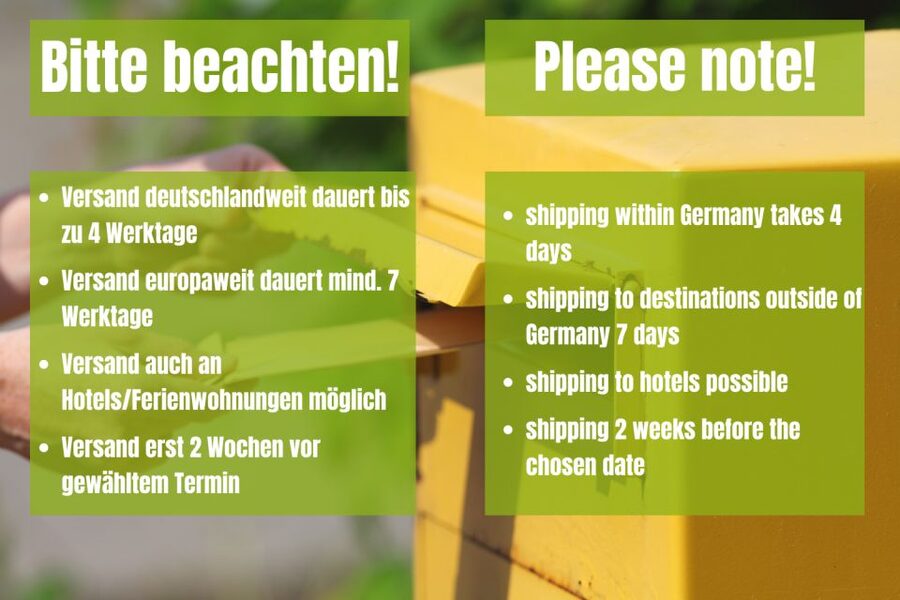
The box is mailed to you, and pickup in Munich is not available. Shipping within Germany can take up to four working days, and the box is shipped no earlier than two weeks before your selected date.
This means you should provide a reliable shipping address and avoid leaving the booking until the last minute. The selected date is not the real start requirement in the usual guided-tour sense. You can use the hunt after the box arrives, regardless of the date and time originally selected.
That flexibility is helpful once the box is in your hands. Before then, it requires a little care. Check the delivery timing before booking, especially if you are traveling from outside Germany or moving between hotels.
Cancellation is available up to 24 hours before the activity for a full refund, and a reserve-now, pay-later option may help if your schedule is still changing. These are useful safeguards, but they do not remove the need to make sure the box can reach you in time.
Who will enjoy this Munich scavenger hunt?
I would recommend it most strongly to:
- Families who want children involved in sightseeing
- Friends who enjoy simple puzzles and a relaxed walk
- Small groups looking for a low-pressure team activity
- Independent visitors who dislike fixed departure times
- People visiting Munich for the first time who want an introduction to the old town
I would be more cautious if you want difficult clues, detailed guiding, or perfectly current information at every stop. The puzzles can feel repetitive and easy, particularly if you know central Munich already. The route also works better when your group enjoys conversation and cooperation, since there is no guide to supply momentum.
Bring comfortable shoes, the mailed box, and a willingness to pause. A phone may be useful for checking practical details, but the game itself is built around the paper materials. Most important, do not judge the experience only by the 270-minute listing. You may finish much sooner, or you may take longer if you stop for food, photos, and sightseeing.
Should you book it?
Book this Munich scavenger hunt if you want a flexible, self-guided way to connect the main old-town sights. The route covers a strong first-time Munich circuit, and the group price is sensible when several people share the box.
Skip it if you expect a demanding puzzle adventure or a detailed guided history lesson. For the best match, think of it as a playful sightseeing framework. It gives you a reason to notice the city, keeps a family or friend group moving together, and lets you set the pace. The simple clues and occasional outdated detail are real limits, but they matter less when your main goal is an independent walk with a bit of friendly competition.
FAQ
Where does the Munich scavenger hunt start?
The scavenger hunt starts at Munich’s main station area. The exact meeting point is provided for the activity, and you need to bring the box you received by mail.
Is there a guide at the meeting point?
No. This is a self-guided activity, so no guide will meet you or lead the walk.
How long does the scavenger hunt take?
The stated duration is 270 minutes. Your actual time can be shorter or longer because you control the pace, pauses, photos, food stops, and sightseeing breaks.
What sights are included on the route?
The route includes Karlstor at Stachus, the Bürgersaal, St. Michael’s Church on Neuhauser Straße, the Frauenkirche, Marienplatz, the Altes Rathaus, the Neues Rathaus, and Viktualienmarkt.
What comes in the scavenger hunt box?
The box contains 16 numbered envelopes with riddles, directions, information, and facts. It also includes an emergency envelope with the solutions.
Can I start on any date and at any time?
Yes. After you receive the box, you can experience the scavenger hunt on any date and at any time. The selected booking date does not limit when you use it.
How is the box delivered?
The scavenger hunt box is sent by mail. Shipping within Germany can take up to four working days, and it is shipped no earlier than two weeks before the selected date. Pickup in Munich is not available.
Are food, transport, and entrance fees included?
No. Food and drinks, travel to and from the activity, transportation tickets, and entrance fees are not included.
Can I cancel the booking?
Yes. You can cancel up to 24 hours in advance for a full refund. A reserve-now, pay-later option is also available.
Just added around Germany
- Berlin: Scavenger Hunt through Friedrichshain★ 4.8 · 9 reviews
- Berlin: Outdoor Escape Game Mitte★ 3.2 · 4 reviews
- Berlin Prenzlauer Berg: Scavenger Hunt Self-Guided Tour★ 4.6 · 14 reviews
- Berlin: EXIT Escape Room Games & Virtual Reality Adventures!★ 4.6 · 3 reviews
- Bautzen: Scavenger Hunt Self-Guided Walking Tour★ 4.9 · 16 reviews
- Bamberg: Mystical Puzzle Tour with Puzzle Backpack and Culinary Delights★ 4.5 · 4 reviews
- Leipzig Center: Crime Mystery Game★ 4.3 · 5 reviews
- Trier Self Guided Sherlock Holmes Murder Mystery Game★ 4.0 · 9 reviews
Scavenger Hunts, compared.

Amazing Cozumel Race: Small-Group Tour and Scavenger Hunt
Read our review →
An Epic Scavenger Hunt: New York City Central Park Adventure
Read our review →
Escaping and spying on the Berlin Wall Scavenger hunt
Read our review →
Browse the lists this tour appears in