
Reviewed · AIX EN PROVENCE
Historical visit/Treasure Hunt of Aix en Provence
Aix-en-Provence reveals itself best on foot, and this two-hour treasure hunt gives you a lively route through its fountains, churches, old squares, and grand 18th-century architecture. Guide Edouard Paul-Cavallier adds stories and small details that help the city make sense, rather than simply pointing out pretty façades.
I like the small maximum of 10 people, which should make it easier to ask questions and keep up with the guide. I also like the route’s mix of art and history, from Delacroix inside Saint-Jean-de-Malte to Roman traces beneath Saint-Sauveur. The main consideration is that the Hôtel de Caumont visit is an exterior stop with admission not included, so this is primarily a walking and storytelling experience.
Key points at a glance
- A treasure hunt with a real walking route: You visit five central sights and finish with a small surprise.
- Edouard Paul-Cavallier leads the tour: Expect an English-language experience with room for questions.
- The route links major Aix landmarks: It begins at La Rotonde and ends at Saint-Sauveur Cathedral.
- Art lovers get a worthwhile stop: Saint-Jean-de-Malte displays Delacroix’s Crucifixion and stained glass.
- The group stays small: A maximum of 10 people keeps the afternoon more personal.
- The price is $42.10: That is fair if you want context and company, but less appealing if you only want to photograph fountains.
Why this Aix-en-Provence walk works
Aix can feel easy to visit and hard to understand. You can stroll beneath plane trees, admire honey-colored façades, and stop for coffee without learning why the streets look the way they do. This tour gives you a framework: Roman beginnings, aristocratic town houses, religious art, public fountains, and the old routes that shaped the city.
The treasure hunt keeps the walk from becoming a string of dates and names. You are not simply following Edouard from one monument to the next. You have a small puzzle to work through, with the promise of a surprise at the end. That format should suit families, couples, and anyone who prefers a little playfulness with their sightseeing.
Edouard’s role matters here. The strongest praise attached to the experience centers on his friendly manner, city knowledge, detailed answers, and ability to mix stories with facts. One particularly useful suggestion is to take the tour early in your stay, since the route can help you understand Aix before you explore it on your own.
The tour is offered in English and begins at 2:30 pm at 2 Place du Général de Gaulle. It ends at Saint-Sauveur Cathedral, so you finish in the historic center rather than returning to the starting point. That makes the walk practical for continuing your afternoon nearby.
More Treasure Hunts in France
- Louvre Guided Treasure Hunt for Families and Kids
★ 4.7 · 92 reviews - Louvre Museum Guided Family Treasure Hunt
★ 5.0 · 78 reviews - “Old Marseille” district tour and treasure hunt
★ 5.0 · 74 reviews
Starting at La Rotonde and reading the city
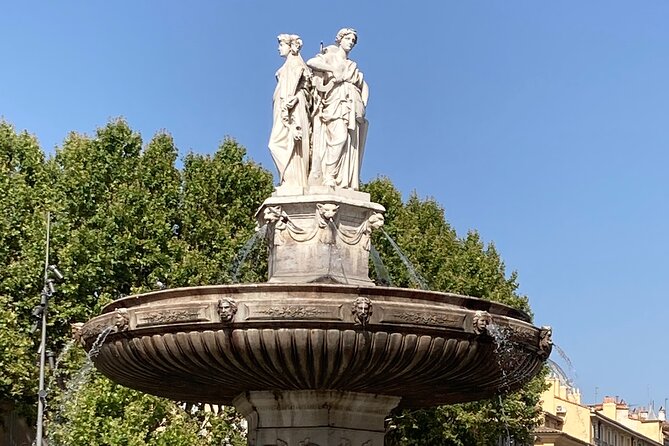
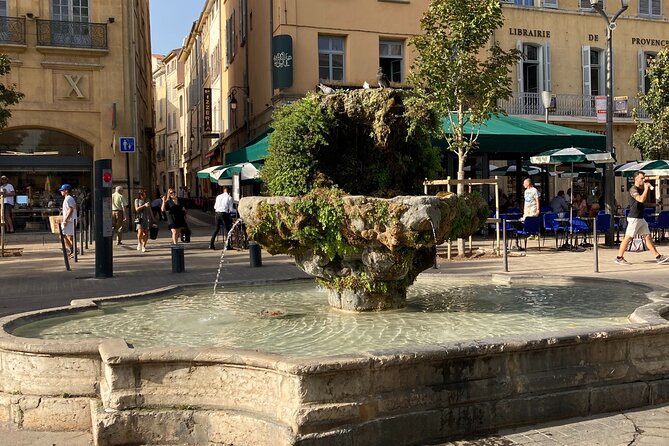
The first stop is Fontaine de La Rotonde, a broad 12-meter fountain at one of Aix’s key meeting points. It has two basins and decorative lions, dolphins, swans, and children created by the sculptor Truphème.
Look above the water and you will see three statues representing Justice, Agriculture, and Fine Arts. Their positions point toward Le Cours, Marseille, and Avignon, creating a kind of road star. The sculptors were Ramus, Chabaud, and Ferrat.
You receive about 10 minutes here, which is enough for an introduction and a quick look at the details. La Rotonde is a busy urban marker, so it is not the quietest place on the route. Its value comes from learning how the fountain connects Aix to its roads, civic ideals, and outward-looking identity.
Starting here is smart. You get an immediate sense of scale, then move into the older streets where the city becomes more intimate. If you arrive early, this is also a clear meeting point in the city center.
The Hôtel de Caumont and Aix’s aristocratic side
The route continues to Hôtel de Caumont in the Mazarin district, one of the city’s most polished quarters. The building follows the Parisian idea of a residence between courtyard and garden, an arrangement that appeared in Paris in the 16th century.
Aix later favored hotels built directly on the street, with more decorated portals and a stronger southern Baroque flavor. Hôtel de Caumont is useful because it lets you compare those two approaches. Its scale is unusual for Aix, and its carriage gate, façade, and wrought-iron stair railing were added to the supplementary inventory of Historic Monuments in 1925. The whole hotel received historic protection in 1987.
The stop itself lasts about five minutes, and admission is not included. That point matters. You should think of this portion as an architectural introduction, not a full visit to the art center or its interiors.
If you want to tour Hôtel de Caumont inside, you would need to arrange and pay for that separately. The treasure walk still gives you a reason to notice the building, but you should not book this experience expecting a gallery visit.
Saint-Jean-de-Malte and a strong art stop
The Church of Saint-Jean-de-Malte is one of the more rewarding stops for visitors who like painting and architecture. Among the works inside, Delacroix’s Crucifixion draws the most attention. The church also contains several stained-glass windows, including one from 1854 centered on the Baptism of Christ.
You have about 15 minutes here. That is not a long church visit, but it gives Edouard time to point out the main artwork and explain why the building matters. The stop breaks up the fountain and street architecture with a quieter interior and a direct look at 19th-century religious art.
This is also where the tour’s artistic side becomes clearest. The experience is not limited to civic monuments or old stones. You get a painting, stained glass, and a church setting that helps show how Aix’s cultural identity extends beyond its famous outdoor streets.
The practical limit is time. If Delacroix is a major reason for your visit, you may want to return later and look more closely. The tour gives you orientation and context, but it is not designed as an extended art study.
Same streets, a different set of clues:
- Saw2 vs Squid Game – Escape Game Montpellier
★ 5.0 · 752 reviews - Prison Break – Escape game in Montpellier
★ 5.0 · 583 reviews - School of Magic – Escape game Montpellier
★ 4.5 · 536 reviews - Mission Possible – Escape game Montpellier
★ 5.0 · 437 reviews
The Four Dolphins Fountain and a small historical puzzle
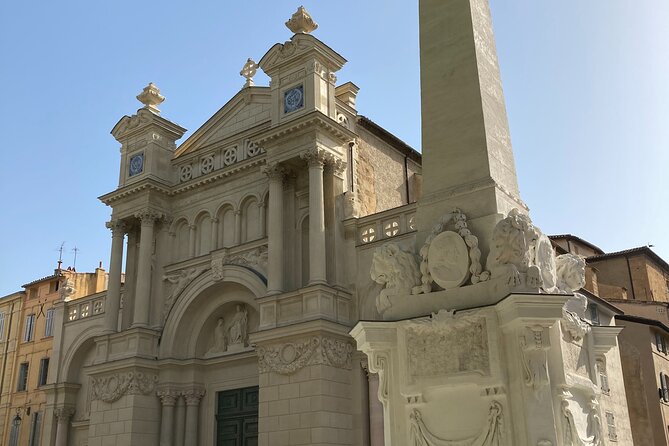
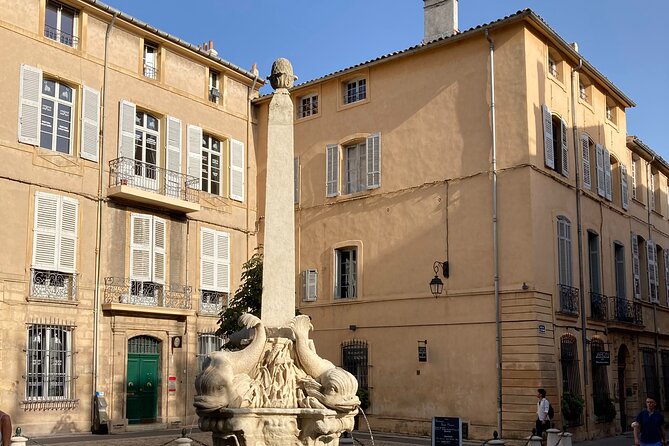
Fontaine des Quatre-Dauphins sits in the middle of its square and dates from 1667. Sculptor Jean-Claude Rambot created four architectural dolphins around a pyramid. The top decoration has changed over time: it originally held a statue of Saint Michael, then a fleur-de-lis, a Maltese cross, and finally a pinecone.
This is a compact stop of about 10 minutes, but it shows how much history can sit in one public fountain. You get sculpture, changing symbols, and a clue to the religious and civic identities that passed through Aix.
The fountain also suits the treasure-hunt format. It has a clear central design and several details worth spotting, so you can look closely instead of treating the square as a quick photo stop. Edouard’s stories should help turn those details into something memorable.
Do not expect a long pause here. The value is in the explanation and the visual search, not in spending half an hour beside the basin. If you enjoy noticing symbols and small changes in historic monuments, this will likely be one of the more satisfying stops.
Saint-Sauveur Cathedral and the Roman past
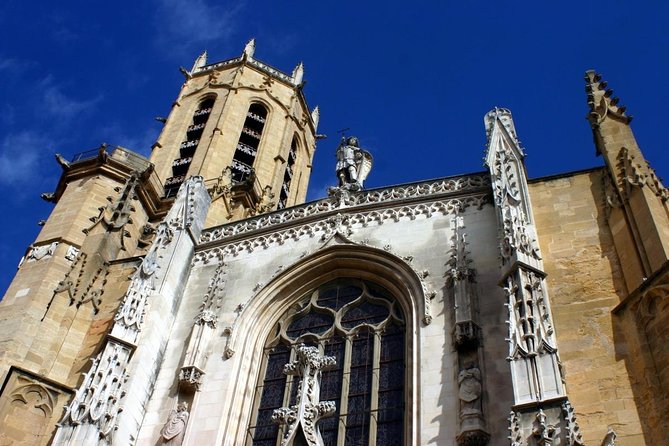
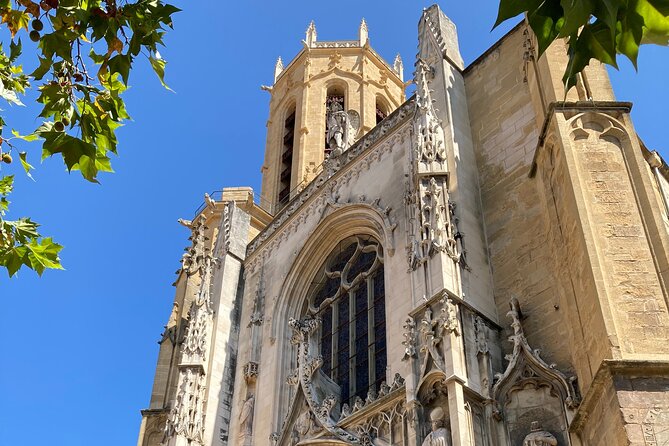
The walk ends at Saint-Sauveur Cathedral, with about 15 minutes devoted to the site. The cathedral sits along the route of the old Via Aurelia, the Roman road that passed through this part of Provence.
A fragment of Roman wall and columns in the baptistery helped create the old story that the cathedral was built on the site of a temple dedicated to Apollo. The historian Pitton made that claim in 1654, linking it to the discovery of a statue with an uncovered thigh and interpreting it as evidence of a solar deity.
You do not need to accept every old theory to enjoy the stop. The useful lesson is that Aix has been repeatedly reinterpreted, with Roman remains, Christian worship, and later historical storytelling layered onto the same place.
Ending here gives the walk a logical finish. You begin with a major modern city junction and finish at one of Aix’s central religious monuments. Since the end point is at Paroisse Cathédrale Saint Sauveur, 34 Place des Martyrs de la Résistance, you can continue exploring the old center after the tour.
What the treasure hunt adds

The treasure hunt is not a separate activity added onto a long sightseeing route. It is a light thread that connects the stops. You look for clues and details, then receive a surprise at the end.
That small reward changes the pace. A standard guided walk can become passive, especially when several monuments appear in a row. Here, you have a reason to pay attention to statues, symbols, and architectural features. The format should work especially well for families with older children, though the tour is also described as relaxing and cozy for adults.
The word treasure should be taken in a playful sense. The information provided does not describe a large prize or elaborate game system. Treat it as a charming finish rather than the main reason to book.
The best part is the balance. You still get real history and art, but the walk does not ask you to memorize a long list of dates. Edouard’s storytelling and answers are central to the experience, while the clues give you something active to do.
Is $42.10 a fair price?
At $42.10 per person, this is not the cheapest way to see Aix’s fountains and churches. Most of the outdoor stops are free, and the tour does not include admission to Hôtel de Caumont. If you are comfortable reading plaques and wandering on your own, you can visit many of the same places without paying a guide.
The price makes more sense if you value interpretation and structure. In two hours, you move through five central locations, hear the links between them, and get an English-speaking guide who can answer questions. You also avoid spending your first afternoon deciding which streets and monuments matter most.
A maximum group of 10 improves the value. A small group gives Edouard more room to respond to individual interests, and it should be easier to see the details he points out. The high 4.9 rating from 12 ratings and the 100 percent recommendation suggest strong satisfaction, though the sample is still small.
I would see this as an orientation tour rather than a bargain attraction ticket. Book it if you want a human guide, a gentle game, and a focused introduction to Aix. Skip it if your priority is a long indoor art visit or a private tour at the lowest possible price.
Timing, meeting point, and walking expectations
The experience lasts about two hours and starts at 2:30 pm. That timing leaves the morning free for a market, a museum, or a slower breakfast, then gives you a useful afternoon introduction to the city.
You start at 2 Place du Général de Gaulle and finish at the cathedral. The route is point-to-point rather than a loop, which is helpful because you do not waste the final minutes walking back to where you began.
The supplied details do not give a total walking distance or explain the exact surface conditions. You should therefore expect a normal city walk and plan for time on your feet. Most people can participate, and service animals are allowed. The meeting area is near public transportation.
Confirmation arrives when you book. Free cancellation is available up to 24 hours before the start time for a full refund. Changes or cancellations made less than 24 hours before the start time are not accepted for a refund, with cut-off times based on local time.
Who should book this Aix tour?
I would recommend it to first-time visitors who want to get their bearings fast without joining a large group. It also fits couples, families, and solo visitors who like a guide with a friendly manner and an activity that keeps the walk from feeling like a lecture.
Art lovers will appreciate Saint-Jean-de-Malte and the Delacroix painting. Architecture fans will get useful context at Hôtel de Caumont, while anyone interested in symbols and civic spaces will enjoy the two fountains. The cathedral gives the route an older Roman and religious layer.
The tour may be less suitable if you want extensive time inside each building. Hôtel de Caumont is not included as an interior visit, and the stops at the churches and fountains are brief. You should also choose another option if you prefer a private experience, since the group can include up to 10 people.
The strongest reason to book is Edouard himself. His role is more than leading you from one address to another. The experience depends on his stories, explanations, and willingness to answer questions, and the available feedback repeatedly praises those qualities.
Should you book Historical Visit and Treasure Hunt of Aix-en-Provence?
Yes, if you want a friendly, small-group introduction to Aix that mixes art, architecture, Roman traces, and a playful search for clues. Book it near the start of your stay so the streets and landmarks make more sense during the rest of your visit.
Think twice if you mainly want paid entry to Hôtel de Caumont, a long look at Delacroix, or a private guide. At $42.10, the value lies in Edouard’s storytelling, the carefully linked route, the small group, and the treasure-hunt finish. For those priorities, this is a well-focused way to spend two hours.
FAQ
How long does the Aix-en-Provence treasure hunt last?
The experience lasts approximately two hours.
What time does the tour begin?
The tour begins at 2:30 pm.
Where does the tour start?
The meeting point is 2 Place du Général de Gaulle, 13100 Aix-en-Provence, France.
Where does the tour end?
The tour ends at Paroisse Cathédrale Saint Sauveur, 34 Place des Martyrs de la Résistance, 13100 Aix-en-Provence, France.
Is the tour offered in English?
Yes. The experience is offered in English.
What is the cancellation policy?
You can cancel up to 24 hours before the experience start time for a full refund. Cancellations or changes made less than 24 hours before the start time are not accepted for a refund.
History tours to book in France
- The Anatomist – Award Winning Historical Escape Room Experience
★ 5.0 · 151 reviews - Private city discovery tour – A Historical Treasure Hunt
★ 5.0 · 146 reviews - Queer Lisbon – A Treasure Hunt in LGBT History
★ 5.0 · 71 reviews - Fort Worth Stockyards History, Food, and Puzzle Tour
★ 5.0 · 38 reviews
Just added around France
- Escape game outdoor The Walking Dead in Tours★ 3.0 · 2 reviews
- Discover Toulouse while playing! Escape game – The alchemist★ 3.5 · 4 reviews
- Tours: Magic Team Escape Game in Town★ 3.0 · 2 reviews
- Romantic Toulouse: Self-Guided Love Story Puzzle Walk★ 4.0 · 2 reviews
- Outdoor escape game | The Minotaur★ 4.5 · 2 reviews
- Urban escape game in Toulouse – Crazytopia★ 3.0 · 3 reviews
- Strasbourg Highlights Self Guided Scavenger hunt and City Walking Tour★ 4.0 · 9 reviews
- Discover Strasbourg while playing! Escape game – The alchemist★ 3.0 · 3 reviews
Treasure Hunts, compared.


St. Augustine: Treasure Hunt Cruise with Onboard Show
Read our review →
Fun, Flexible Treasure Hunt Around Manchester with Cryptic Clues & Hidden Gems
Read our review →
Fun, Flexible Treasure Hunt Around York with Cryptic Clues & Hidden Gems
Read our review →
Fun, Flexible Treasure Hunt Around Bath with Cryptic Clues & Hidden Gems
Read our review →York Treasure Hunt Adventure: The Mystery of The Gunpowder Snitch
Read our review →Browse the lists this tour appears in