
Reviewed · BERLIN
Love and War in Berlin: Self-Guided Story Puzzle Walk
Berlin’s central sights become a trail of clues on this self-guided story puzzle walk, which links Alexanderplatz with the Memorial to the Murdered Jews of Europe. Along the way, you’ll move through places tied to Prussian rule, Nazi persecution, the GDR, and the Second World War.
I like the very low $6 price and the freedom to start at any hour, stop for a coffee, and continue later. I also like that the route uses major public sights rather than hiding the story inside a museum. The drawback is that the puzzle format can feel less smooth than a live guide, especially when an answer must be entered with exact wording.
Key things to know before you play
- Start at the World Clock: Begin at Alexanderplatz, beside the Urania World Clock, a useful and easy-to-find meeting point.
- Follow Berlin’s political story: The route connects royal, Nazi, communist, and modern German landmarks.
- Expect a puzzle at every stage: You must observe your surroundings and solve clues to receive the next location.
- Finish near the Holocaust Memorial: The walk ends at Cora-Berliner-Straße, close to the Memorial to the Murdered Jews of Europe.
- Play without a guide or internet connection: This is a private activity for your group, delivered through a mobile ticket and playable offline.
- Allow flexibility, but watch the clock: The listed playing time is about one hour, and the activity is available daily from 5:00 AM to 9:00 PM.
A history walk that begins with a world clock
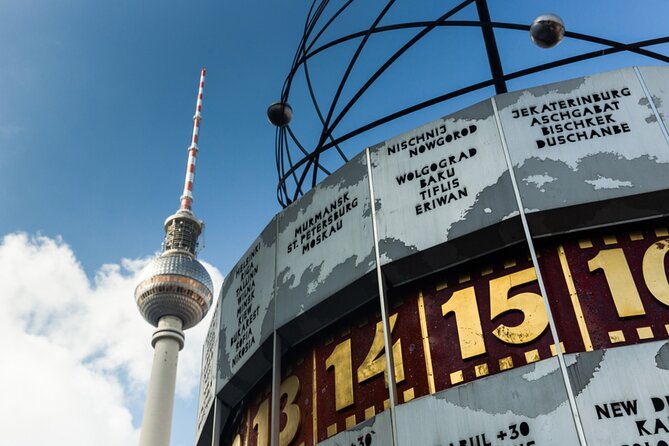
The experience starts at Alexanderplatz, one of Berlin’s best-known public squares. Look for the World Clock, also called the Urania World Clock, a large turret-style structure showing the current time in 148 cities.
This is a clever starting point. It gives you a clear landmark, and the clock itself offers an early observation challenge. Rather than simply being told where to go, you must inspect the structure and find the information needed to continue.
Alexanderplatz is also a useful place to begin because it is well served by public transport. You do not need to meet a guide or wait for a group to gather. Once your booking is confirmed, your group can begin during the stated operating hours.
The route then moves toward Berlin’s old civic center and the former East Berlin area. The activity uses short story sections and questions to keep you looking closely at the city around you. If you enjoy city walks that give you a reason to read plaques, count details, and examine statues, this format should suit you.
More Self-Guided Games in Germany
- Berlin: Self-Guided Family and School Class Scavenger Hunt
★ 4.6 · 128 reviews - Berlin: Scavenger Hunt Self-Guided Tour
★ 4.6 · 79 reviews - Berlin Wall: Greatest Escapes Self-Guided Walking Adventure
★ 4.5 · 27 reviews
Berlin’s Rathaus and the Neptune Fountain
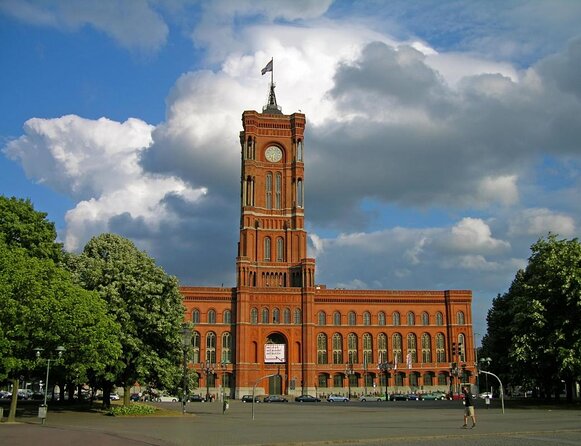
One early stop is the Rathaus, Berlin’s red-brick city hall. Hermann Friedrich Waesemann built it between 1861 and 1869 in a Northern Italian High Renaissance style. Its design drew on the old town hall of Toruń, while its tower recalls the cathedral tower at Laon in France.
You get a useful lesson here in how Berlin borrowed ideas from other parts of Europe. The building is not simply a backdrop for a clue. It helps explain the city’s 19th-century confidence, when Berlin was growing into a major imperial capital.
The route continues to Neptunbrunnen, the Neptune Fountain, created in 1891 by Reinhold Begas. Neptune sits at the center, surrounded by allegorical figures representing rivers. The stop is free, outdoors, and usually easy to combine with a short pause.
The puzzle format gives these places a practical purpose. You are not rushing past them just to reach the next famous square. You need to inspect the setting before moving on, which can help you notice architectural and sculptural details that a fast city walk might miss.
From Marx and Engels to the Lustgarten
The next part brings you through Marx-Engels-Forum, a public park created by the former German Democratic Republic in 1986. It is named for Karl Marx and Friedrich Engels, the authors of The Communist Manifesto.
This stop gives the walk a clear change of tone. The earlier buildings reflect imperial Berlin, while Marx-Engels-Forum points to the political ideals of East Germany. The route is not only about the Second World War. It also shows how Berlin’s public spaces were reshaped by different governments and competing ideas.
You then reach the Lustgarten on Museum Island. The name means Pleasure Garden, though the space has served many purposes over time. It was once part of the Berlin City Palace grounds, and later functioned as a parade ground, a place for mass rallies, and a public park.
I like this part of the route because the locations are close to major landmarks, yet the activity asks you to consider how public space can change meaning. A square used for royal display, military ceremony, political rallies, or daily relaxation is never just an empty patch of pavement.
The walk remains outdoors and admission is free at these stops. If you want to spend longer looking around, you can pause the game. That flexibility is one of the strongest reasons to choose this format instead of a tightly timed group walk.
Neue Wache and the memory of war
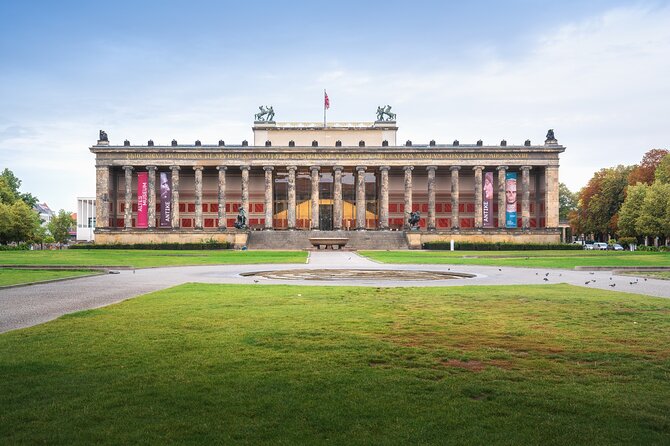
On Unter den Linden, the route reaches Neue Wache, a neoclassical building designed by Karl Friedrich Schinkel and built between 1816 and 1818. It began as a guardhouse for the Royal Palace and a memorial to the wars of liberation.
The building’s purpose changed over time, and its location makes it a useful point for thinking about Berlin’s shifting memory of conflict. The activity connects the architecture with the wider story of war, power, and remembrance.
The route then reaches Bebelplatz, one of Berlin’s most important sites connected with Nazi cultural persecution. On the evening of May 10, 1933, Nazi-organized book burnings took place here and in other German university cities.
This is a serious stop, and the puzzle format may feel more restrained here than it does at a fountain or clock. You will need to look carefully and answer the challenge before continuing, but the place rewards a slower pause. Bebelplatz is a reminder that authoritarian rule attacks ideas and public debate as well as people.
The activity’s focus on observation can work well at memorial sites, but you should set your own pace. If you want time to read and reflect, do not feel obliged to rush simply because the listed duration is about one hour.
More Puzzle Walks and Quests in Berlin:
- Spy Mission in Berlin: Self-Guided Espionage Puzzle Quest
★ 5.0 · 3 reviews - Fun, Flexible Treasure Hunt Around Manchester with Cryptic Clues & Hidden Gems
★ 5.0 · 253 reviews - Fun, Flexible Treasure Hunt Around York with Cryptic Clues & Hidden Gems
★ 5.0 · 248 reviews - Fun, Flexible Treasure Hunt Around Bath with Cryptic Clues & Hidden Gems
★ 5.0 · 208 reviews
Gendarmenmarkt and Berlin’s public face
Gendarmenmarkt is another major square on the route. Its name comes from the Gens d’Armes cuirassier regiment, whose stables once occupied the site. Friedrich II later had the stables demolished, and the square developed around two churches and a theater, now known as the Konzerthaus Berlin.
This is one of the route’s more visually impressive settings, although the experience is not built around entering the buildings. You are exploring the public square and using its details to answer the next question.
Gendarmenmarkt also helps connect architecture with political history. The square has been shaped by military use, royal planning, religious buildings, and performance. The game uses that setting to keep the walk moving without requiring an admission ticket.
After Gendarmenmarkt, the route passes the state representation of Hamburg in Berlin. This classicist townhouse is used for political meetings, public events, and work connected with Germany’s federal system. The 16 federal states take part in national legislation through the Bundesrat, and Hamburg’s representation gives the city a place in that process.
This stop may be less famous than the big squares, but that is part of its value. You get a glimpse of how modern Germany works, not just a parade of monuments from the past.
The former bunker site and the Holocaust Memorial
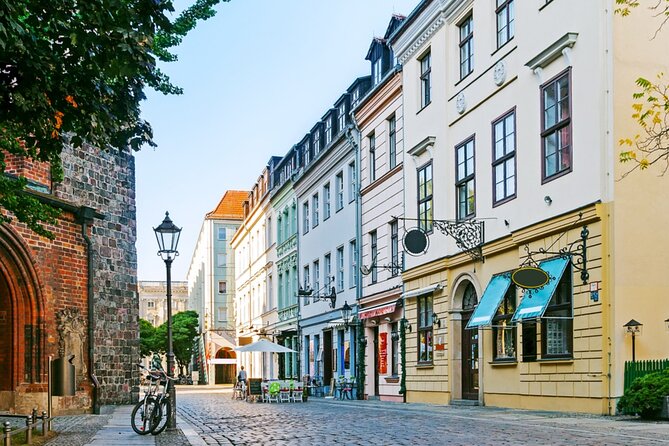
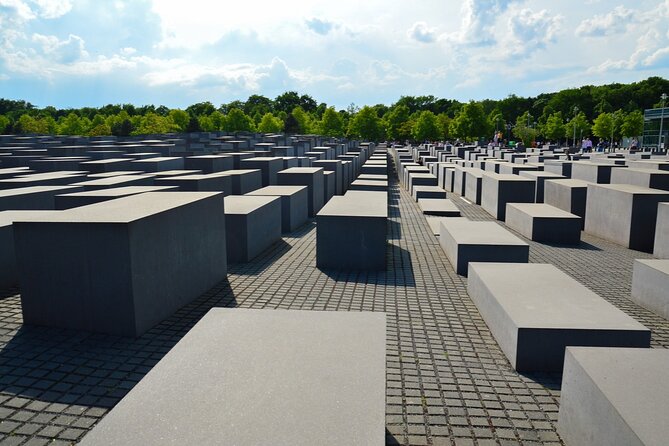
The final section brings the route toward the Memorial to the Murdered Jews of Europe. The memorial was approved after long debate in 1999, designed by New York architect Peter Eisenman, and opened in 2005.
The route also points you toward the site of Hitler’s former war bunker. You should understand what this means in practical terms: the bunker itself is not presented as an attraction to enter. The important point is the location and the historical context around it.
The walk ends at Cora-Berliner-Straße 1, beside the Holocaust Memorial area. This gives the experience a weighty finish. You move from public squares and civic buildings to a memorial devoted to the Jewish victims of Nazi persecution.
You may want to allow more than the nominal one hour if you plan to walk through the memorial afterward or visit its underground information center. The supplied duration is for the puzzle walk itself, not for a full visit to every nearby site.
How the puzzle system works in practice
At each stop, you look around for the answer to a question. Solving it allows you to advance to the next location and receive more of the story.
That simple structure makes the walk more engaging than following a list of directions. It also means the experience depends on your willingness to observe. You are not only walking from point to point. You are searching for information in the setting.
The difficulty appears mixed. Some questions are easy, while others require more exact answers. A small wording error can prevent you from moving on, so read the instructions carefully and enter answers precisely.
This is worth knowing if you prefer a smooth, guided narrative. A live guide can rephrase a question or explain an answer at once. Here, you may need to try again or inspect the location more closely.
The route is private, so only your own group participates. That makes it a good choice for couples, families, or friends who want to talk among themselves rather than keep up with strangers. It also avoids the fixed social rhythm of a large walking tour.
Timing, transport, and practical value
The activity costs $6 per person, which is unusually modest for an organized Berlin experience. You are paying for a short digital game and route, not museum admission, transport, or a human guide.
At that price, the value is strongest if you want a low-cost introduction to central Berlin. You can see a chain of important places without booking an expensive private tour. The route also gives structure to a part of the city that can otherwise feel like a loose collection of squares and monuments.
The listed duration is about one hour. Three highlighted stops, Neptunbrunnen, Bebelplatz, and Gendarmenmarkt, are each allocated about 10 minutes. In practice, your total time can vary because you are free to pause, take photographs, stop for food, or spend longer at a memorial.
The activity operates Monday through Sunday from 5:00 AM to 9:00 PM. It is available to book every day, and you can start at any hour within those operating times. A mobile ticket is required, but the game can be played offline, so you do not need a live internet connection while walking.
The meeting point is Alexanderplatz 1. The endpoint is Cora-Berliner-Straße 1. The route is near public transport, and service animals are allowed. Most people can participate, though the experience requires walking between outdoor locations and using a phone to read and solve the clues.
Free cancellation is available if you cancel at least 24 hours before the scheduled start time. Cancellations made within 24 hours are not refunded.
Who will enjoy this Berlin walk?
I would choose this activity if you like history but do not want a long lecture. The questions give you a reason to stay alert, and the route covers a wide stretch of Berlin’s political story in a compact format.
It is also a good fit for repeat visitors. Even someone who has lived in Berlin for years may find a new detail or an unfamiliar public building along the way. The route includes famous places, but it also adds less obvious stops such as the Hamburg state representation.
Families with older children may enjoy the game element, especially if they divide up the clues and solve them together. Couples and small groups will appreciate being able to set their own pace.
I would be more cautious if you want detailed historical explanation at every stop. The game gives you a route and a story, but it does not replace a full guided tour or museum visit. You should also avoid starting when you are in a hurry. Exact answers and temporary obstructions, such as a Christmas market, can make the route less direct.
Should you book Love and War in Berlin?
Book it if you want a cheap, flexible way to connect central Berlin’s major sights. The combination of Alexanderplatz, Bebelplatz, Gendarmenmarkt, Neue Wache, the former bunker site, and the Holocaust Memorial gives the walk a strong historical arc.
Skip it if you prefer a human guide, long explanations, or a completely effortless route. The puzzles can be uneven, and exact answer wording may test your patience.
For $6, I think the activity offers good value as a compact introduction to Berlin’s central monuments. Treat it as a smart walking framework, not a substitute for a full history tour. Bring a charged phone, start with enough time to pause, and give the serious memorial sites the attention they deserve.
FAQ
How much does the Love and War in Berlin walk cost?
The price is $6 per person. Group discounts are available.
How long does the activity take?
The listed duration is approximately one hour. You can take breaks and resume later, so your total time may be longer.
Where does the walk start?
It starts at Alexanderplatz 1, 10178 Berlin, beside the World Clock area.
Where does the walk end?
The endpoint is Cora-Berliner-Straße 1, 10117 Berlin, near the Memorial to the Murdered Jews of Europe.
Is a guide included?
No physical tour guide is included. This is a private, self-guided activity for your group.
Do I need an internet connection?
No. The city game can be played offline after you have accessed it on your mobile device.
What is the cancellation policy?
You can receive a full refund by cancelling at least 24 hours before the experience start time. Cancellations made less than 24 hours in advance are not refunded.
More Self-Guided Games in Berlin
- Berlin Kreuzberg: Scavenger Hunt Self-Guided Tour
★ 4.1 · 19 reviews - Berlin Prenzlauer Berg: Scavenger Hunt Self-Guided Tour
★ 4.6 · 14 reviews - Berlin Scavenger Hunt and Highlights Self-Guided Tour
★ 4.0 · 7 reviews - Berlin Highlights Self guided scavenger hunt and Walking Tour
★ 4.5 · 4 reviews
Just added around Berlin
- Winter is Coming Live Escape Room in Berlin★ 3.0 · 5 reviews
- Private Tutankhamun’s Tomb Live Escape Room in Berlin★ 3.5 · 11 reviews
- Kreuzberg’s Secret Society: Exploration Game and Tour★ 4.5 · 3 reviews
- Scavenger Hunt from Maranja Adventure Club★ 5.0 · 6 reviews
- Berlin Highlights Self guided scavenger hunt and Walking Tour★ 4.5 · 4 reviews
- Berlin stories – an exciting scavenger hunt tour★ 3.5 · 2 reviews
- Berlin Scavenger Hunt and Highlights Self-Guided Tour★ 4.0 · 7 reviews
- First Profiler Berlin: Private Self-guided Outdoor Escape Game★ 3.5 · 3 reviews
Self-Guided Games, compared.

Browse the lists this tour appears in