
Reviewed · LONDON
Interactive Treasure Hunt London – City of London/Southwark
London’s past becomes a game on this three-hour walking trail through the City of London and Southwark. You solve riddles about kings, inventions, bridges, medieval entertainment, and strange public art while moving between the Thames, market streets, and old urban corners. I like the self-guided freedom and the way the route points you toward sights you could easily miss. I also like having three clue styles, including Spanish, so your group can choose its own pace.
The main concern is distance. This is not a short stroll, and one participant found that some clues did not line up neatly with the location. You also need a working phone connection to reach some points, so download the app and prepare for a little detective work when the signal is weak.
Key points at a glance
- A three-hour route from St. Paul’s to Southwark: You begin at St. Paul’s, Cheapside, and return to the same meeting point.
- Clues with three levels of feel: Choose Classic, Relaxed, or Spanish clues, then change your choice during the game.
- A playful route across London’s past: Expect references to a king who united England and Scotland, the inventor of dawn, medieval pleasure districts, frozen fairs, and a sinister bishop.
- Stops beyond the usual postcard views: The trail includes riverside scenery, unusual bridge artwork, sculptures, a historic market, and places to pause for food or drink.
- A private game for up to five people: Your group plays together rather than joining a larger walking tour.
- A walking activity with a weather catch: You need moderate fitness, and poor weather can lead to a new date or a full refund.
Starting beneath St. Paul’s, with London as your game board
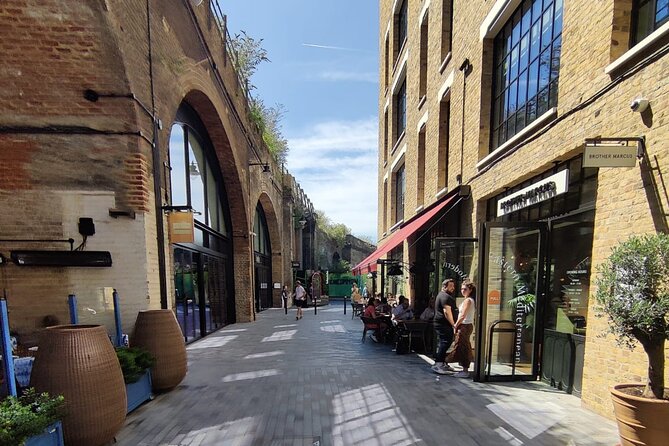
Your meeting point is St. Paul’s, Cheapside, in the City of London. That puts you in one of the capital’s oldest commercial areas, surrounded by office towers, churchyards, lanes, and traces of the medieval city.
The route does not ask you to sit through a long introduction. Instead, the app gives you a puzzle trail to follow. You read a clue, work out the answer, and use it to decide where to go next. That format suits you if you prefer to keep moving and make discoveries at your own speed.
I like the fact that the experience starts with a sense of purpose. You are not simply wandering around looking for old buildings. The clues give you a reason to notice a name, statue, bridge detail, or odd bit of street design.
The private format matters here. With up to five people, you can stop when you need to, argue over an answer, or take a break without holding up strangers. It is a good fit for friends, couples, or a family with older children who enjoy puzzles more than formal sightseeing.
More Treasure Hunts in London
- London: Food Treasure Hunt and Walking Tour
★ 5.0 · 92 reviews - Interactive Treasure Hunt Experience – Central London’s Secrets
★ 4.5 · 43 reviews - Immersive Treasure Hunt Adventure – City of London’s Secrets
★ 4.5 · 41 reviews
The opening riddles and London’s unusual characters

Early clues introduce figures and ideas tied to England’s past. One clue points toward the person known as the unifier of England and Scotland. Another refers to the inventor of dawn. The wording is deliberately playful, so the fun comes from making connections rather than being handed a standard museum label.
This style gives the walk a different rhythm from a conventional history tour. You learn facts as part of a problem, then see the surrounding streets with a more alert eye. If you enjoy pub quizzes, escape rooms, or city games, this should feel natural.
The tradeoff is that a riddle can be less clear than a guide’s explanation. If your group gets stuck, you may spend several minutes testing guesses that do not work. The clue system can also feel slightly loose at times, especially if the wording does not point cleanly to the exact place.
You can switch between Classic, Relaxed, and Spanish clues at any point. That is useful if the Classic version becomes too demanding, or if someone in your group prefers Spanish. It also means you are not locked into your first choice after the walk has already begun.
Crossing a bridge covered in chewed-up artworks
One of the route’s most unusual moments comes at a bridge decorated with what the description calls chewed-up artworks. This is not the polished London many first-time visitors expect. You get an example of how public art can be odd, playful, and slightly unsettling.
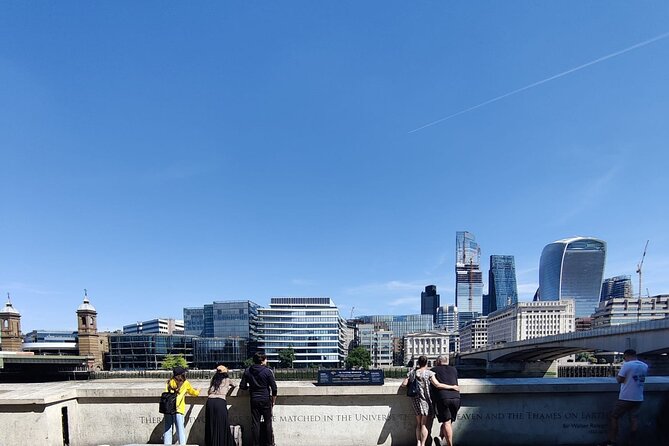
The bridge also brings the Thames into view. Riverside stops are valuable on a route like this because they give your legs a break from tight streets and let you see the city from a wider angle. Take time here to look around rather than rushing to the next answer.
This is also where practical planning matters. The route is delivered through your phone, and one user had trouble reaching a requested location when there was no signal. Download the chosen app before you start, keep your phone charged, and avoid treating every clue as obvious on the first reading.
I would not book this expecting a perfectly guided line from one landmark to the next. You are playing a location-based game, and part of the experience is working through uncertainty. If that sounds irritating, a traditional walking tour may suit you better.
Southwark’s medieval pleasure district
After the bridge, the trail moves into Southwark and its medieval pleasure district. This section gives the walk its strongest historical character.
Southwark once had a reputation for entertainment outside the strict control of the City. The route uses that setting to introduce a less formal side of London’s past, one shaped by play, spectacle, markets, drinking places, and public gatherings.
The experience does not present this history as a long lecture. Instead, you meet it through clues and short pieces of information. That makes the material easier to absorb while walking, though you should not expect the depth of a specialist history tour.
The references to frozen fairs add another memorable detail. These fairs took place when the Thames froze hard enough for public activity on the ice. It is a striking reminder that London’s river has not always looked or behaved as it does today.
The sinister bishop adds a darker note. The trail appears to balance comic clues with stories that have a sharper edge, which keeps the walk from becoming a simple list of cheerful facts.
More Treasure Hunts in the UK
- Immersive London Treasure Hunt Adventure – Outdoor Escape Room
★ 5.0 · 11 reviews - London: British Food Treasure Hunt With Gourmaze
★ 5.0 · 4 reviews - Cluefall – Immersive Treasure Hunt in London’s South Bank
★ 5.0 · 3 reviews - Interactive Treasure Hunt Experience of Greenwich’s Secrets
★ 5.0 · 2 reviews
A market stop gives the route breathing room
A historic market is one of the walk’s planned pauses. The exact stop is part of the route rather than a separate booking, and it gives you a natural place to rest, eat, or look around.
That pause is important because the walk can run close to three hours and may cover a long distance. You should not assume that every minute will be spent solving clues. Time at the market can help your group regroup, check the app, and decide how much energy remains.
The route also includes a pub and other possible rest spots. You are not forced into a fixed meal or scheduled stop, so you can keep the break brief or take more time. The flexible setup works well if one person wants to browse while another wants to sit down.
Keep in mind that stopping for food or drink may extend the total time. The advertised duration is approximate, not a promise that you will finish in exactly three hours. If you have a timed reservation afterward, allow a generous cushion.
Sculptures, river views, and a steampunk finish
The later part of the trail brings together sculptures, the river, and what is described as a steampunk fantasy. That combination gives the experience a deliberately mixed character. You move from medieval stories to modern public art, then into a more imaginative visual world.
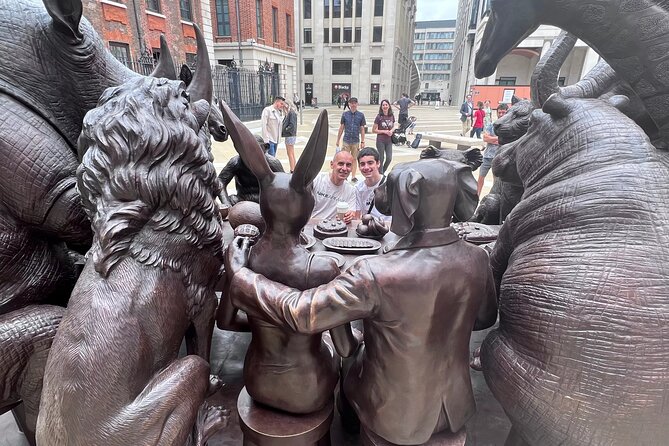
The sculpture stops are especially useful for people who want more than standard sightseeing. Public art can be easy to pass without a second glance, but a clue makes you stop and study it. You may notice materials, shapes, or small details that would otherwise disappear into the background.
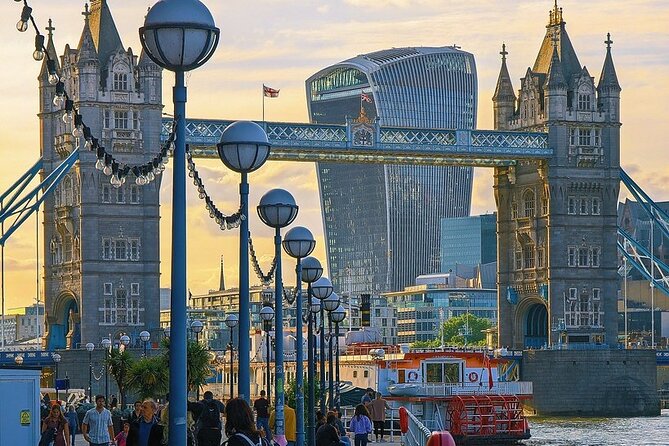
The riverside sections provide some of the best visual variety. You get open views after narrower city streets, along with changing perspectives on bridges and the water. Bring a camera if you like unusual urban scenes, but remember that the game still needs your attention.
The steampunk element may appeal most to people who enjoy a little theatrical flavor. It adds a fantasy note without turning the whole route into a staged performance. There is no live guide or actor waiting at each stop, so the atmosphere comes from the settings and the clues.
What the $24.07 price really buys you
At about $24.07 per person, this is priced below many guided London walking tours, but the comparison needs care. You are paying for the designed route, app access, puzzles, and the work of connecting scattered sights. You are not paying for a guide, transport, food, or entry to a major attraction.
The value is best if two to five people play together. A group can divide the cost while sharing the same activity, and the private format gives you control over breaks and pace. For one person, the price may feel less attractive because you also carry the burden of solving every clue alone.
I see the main value in the route design. You could walk around the City and Southwark without spending anything, but you might miss the bridge artwork, sculptures, historical references, and small links between places. The app supplies a reason to connect them.
The value is weaker if you want a polished, fact-heavy tour with a live expert. You may need to interpret a clue, retrace a few steps, or accept that an answer is not immediately clear. The experience rewards curiosity more than efficiency.
How difficult is the walk?
You should have a moderate level of fitness. The route involves sustained walking, and one participant described it as a long way. No exact mileage is provided, so I would not book it for anyone who needs a very short, low-effort route.
Wear comfortable shoes and plan for changing conditions. The experience requires good weather, and poor weather can cause a cancellation with either a different date or a full refund.
The route’s private nature lets you slow down, but it does not remove the physical demands. A group can take breaks at the market, pub, or other points, yet you still need to reach the next clue.
This activity suits you if you enjoy walking as part of the entertainment. It is less suitable if you mainly want to sit, take photos, and listen to a guide explain each stop.
Phone preparation can make or break the game
The mobile ticket and app are central to the experience. You should have the app ready before arriving at St. Paul’s and make sure your phone has enough battery for several hours of navigation and puzzle solving.
Signal problems are the clearest practical weakness. If the app needs to direct you to a location and your phone cannot connect, progress may stop. Download anything the provider allows in advance, and consider carrying a portable battery.
Do not assume every clue will match its setting with complete precision. If a location seems wrong, reread the wording, check that you are at the correct point, and give yourself time to test another interpretation. A little patience helps, but this is not the ideal activity for someone who dislikes uncertainty.
The ability to change clue style mid-game is a useful safety valve. You can move from Classic to Relaxed if the puzzles slow your group down, or choose Spanish if that works better for your party.
Who will enjoy this London trail?
I would recommend it most strongly to:
- Friends who like riddles and city exploration
- Couples who want a private activity rather than a group tour
- Families with older children who can manage a long walk
- Visitors who have already seen London’s major landmarks and want a different angle
- Spanish-speaking groups who want that clue option
- Independent visitors who dislike fixed guide schedules
The experience is less suited to people who want exact historical detail, a short route, or a guaranteed smooth progression from stop to stop.
It also works best when your group has a shared sense of humor. You will need to debate answers and accept a few wrong turns. That can be part of the fun, but only if everyone treats the puzzle as the point rather than an obstacle.
Booking, cancellation, and practical details
You receive confirmation when you book, and the activity is near public transport. The meeting point is St. Paul’s, Cheapside, and the walk ends back there.
The activity is private, with only your group taking part. Service animals are allowed. You can cancel for a full refund up to 24 hours before the start time, but cancellations or changes made inside that window are not refunded or accepted.
The experience is booked, on average, 72 days ahead. That does not mean you must reserve it that early, but it suggests that planning ahead is sensible if you need a particular date.
The published rating is 3.6 from five ratings, so the sample is small. I would treat that number as a sign to set realistic expectations: the concept is appealing, but the phone-based clues and walking demands will not suit every group.
Should you book the City and Southwark treasure hunt?
Book it if you want a private, playful walk through London with unusual art, river views, market time, medieval stories, and puzzles instead of a standard guide talk. The ability to choose Classic, Relaxed, or Spanish clues gives your group useful control.
Skip it if you need a short route, dependable phone service at every point, or a guide who can explain each detail immediately. My practical advice is to wear good shoes, charge your phone, download the app before starting, and leave plenty of time for wrong guesses and rest stops.
For the right group, the price is fair because you get a structured way to notice parts of London you might otherwise walk past. Just see it as a city game with historical content, not as a fully guided sightseeing tour.
FAQ
Where does the treasure hunt start?
It starts at St. Paul’s, Cheapside, London EC2V 6AA.
Where does the activity end?
The activity ends back at the meeting point.
How long does the treasure hunt take?
The activity lasts approximately three hours.
How many people can play together?
You can add up to five people to play in your private group.
Which clue formats are available?
You can choose Classic, Relaxed, or Spanish clues.
Can I change the clue format during the game?
Yes. You can change your set of clues at any time during the game.
What happens if bad weather cancels the activity?
If poor weather causes a cancellation, you will be offered a different date or a full refund.
Just added around London
- Zombie Scavengers Game – Southend-on-Sea, UK★ 4.5 · 2 reviews
- Undercover Agent Escape Game – High-Tech Spy Thriller★ 5.0 · 2 reviews
- Secrets of Bermondsey: Self-Guided Urban Puzzle Walk★ 5.0 · 2 reviews
- Unique Survival Scavenger Hunt in Luton by Zombie Scavengers★ 3.0 · 2 reviews
- Private Prison Van Escape Game – London Immersive Experience★ 4.0 · 15 reviews
- London Self-Guided Sherlock Holmes Murder Mystery Game★ 4.0 · 2 reviews
- e-Scavenger Hunt London: Explore the City at Your Own Pace★ 4.5 · 3 reviews
- London Murder Mystery Dinner Cruise★ 3.5 · 9 reviews
Treasure Hunts, compared.


St. Augustine: Treasure Hunt Cruise with Onboard Show
Read our review →

Fun, Flexible Treasure Hunt Around Manchester with Cryptic Clues & Hidden Gems
Read our review →
Fun, Flexible Treasure Hunt Around York with Cryptic Clues & Hidden Gems
Read our review →
Fun, Flexible Treasure Hunt Around Bath with Cryptic Clues & Hidden Gems
Read our review →York Treasure Hunt Adventure: The Mystery of The Gunpowder Snitch
Read our review →Browse the lists this tour appears in