
Reviewed · CHICAGO
Eastside Chicago The Heist Exploration Game and Tour
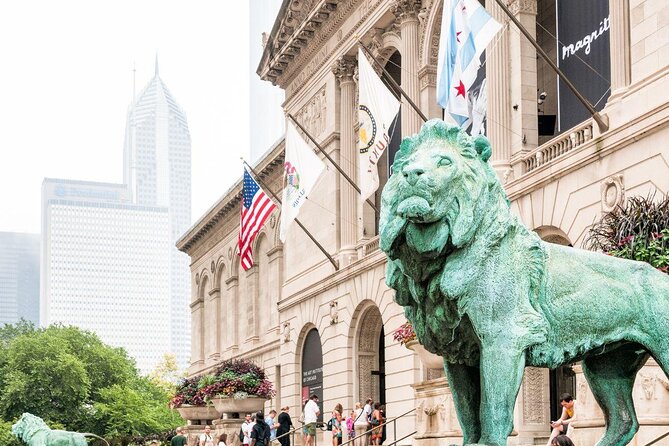
Chicago’s Heist Exploration Game turns a walk from the Art Institute toward Grant Park into a clue-solving outing. Instead of following a guide, you use your phone to find landmarks, answer questions, and move from one location to the next. The route brings together famous public art, grand fountains, old architectural fragments, and stories tied to Chicago’s rebuilding after the Great Fire.
I like two things here: the low price makes it an easy add-on to a day downtown, and the self-guided format lets you stop for photos, snacks, or a closer look at the art. The main caution is practical: construction, GPS range, or connection trouble can interrupt the game, so this works best for people who can stay patient when the technology needs a little help.
Key points to know before you play
- A 95-minute route through central Chicago: The game links the Art Institute, Millennium Park, Grant Park, and several nearby landmarks.
- A phone replaces the guide: You receive clues, location prompts, and challenges through the app, with no physical guide meeting your group.
- Offline play is included: You do not need an internet connection once the game is ready to use.
- The price is unusually modest: At $7.20 per person, it costs less than many guided city activities, though the experience depends on how well the app works.
- You will walk a lot: Comfortable shoes matter, especially if you want to explore each stop rather than rush through the clues.
- The route mixes famous and overlooked sights: Cloud Gate and Crown Fountain draw the crowds, while the Chicago Stock Exchange Arch and Taft’s Fountain of the Great Lakes reward closer attention.
How the self-guided Chicago game works
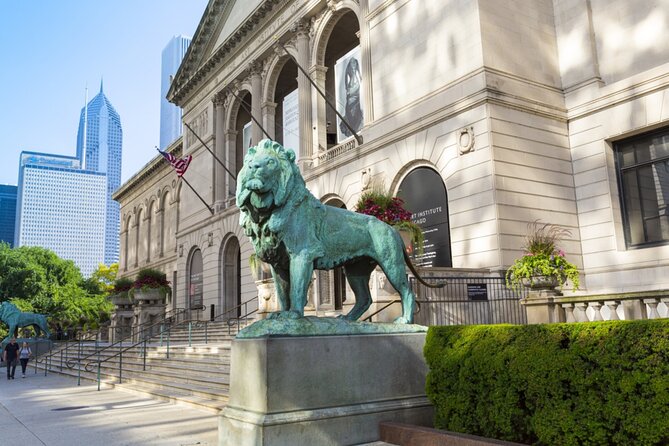
You begin at 111 South Michigan Avenue, outside the Art Institute of Chicago. From there, the phone-based game sends you toward a series of stops. At each one, you look around for an answer, enter it, and receive the next location and a short story about the site.
That structure gives the walk a purpose. You are not simply ticking off monuments from a list. You have to notice details on buildings, sculptures, fountains, and signs. For families or friends, the questions can turn a normal downtown walk into a small team activity.
The game is private, so only your group takes part. You can start at any hour, seven days a week, and stop whenever you like. That flexibility is useful in Chicago, where weather, museum plans, lunch reservations, and sudden fatigue can change your schedule quickly.
The full route is advertised at about one hour and 35 minutes. In practice, plan extra time if you want photographs, read the history, or pause at Millennium Park. The walk covers a fair amount of ground. You should wear comfortable shoes and keep your phone charged.
The app is designed to work offline, which is a real advantage. You do not need to keep searching for a strong signal as you move through the city. Still, the location features need to recognize where you are, and that can be less exact around crowded spaces, construction zones, or restricted areas.
More City Exploration Games in the USA
- San Francisco Haight Ashbury Hippie Exploration Game
★ 4.5 · 13 reviews - San Diego: Balboa Park Botanical Exploration Game
★ 4.5 · 12 reviews - New Orleans: City Park Exploration Game and Tour
★ 4.0 · 10 reviews
Starting at the Art Institute of Chicago
The first stop is the Art Institute of Chicago, founded in 1879 as both a museum and an art school. That date matters. Chicago was rebuilding after the Great Fire of 1871, and the museum formed during a period when civic leaders were trying to give the growing city cultural institutions to match its commercial power.
The game asks you to look around for an answer before moving on. This makes the museum more than a starting pin on a map. You begin by paying attention to the building and its setting, rather than walking past it on the way to Millennium Park.
The nearby School of the Art Institute of Chicago receives its own stop later in the route. It began in 1866 as the Chicago Academy of Design, founded by 35 artists. That connection between museum and school gives the opening section a useful theme: Chicago’s art scene grew through both public collections and formal training.
You should note that this activity does not include museum admission or a physical guide. The focus is on outdoor places and the clues delivered through the phone.
Calder’s Flying Dragon and the art of noticing details
One stop features Alexander Calder’s Flying Dragon, a stainless steel sculpture covered in his familiar red-orange color. Calder worked across about five decades, and his public art often uses bold shapes and strong color to make a large urban setting feel more playful.
The challenge asks you to inspect the work and find the needed answer. That is a good match for Calder’s sculpture, since the piece changes as you walk around it. From one angle, its sweeping form may look compact. From another, it seems to reach into the surrounding space.
This is one of the better reasons to choose a game instead of a standard sightseeing checklist. A clue gives you a reason to examine a work that you might otherwise photograph quickly and leave behind.
Crown Fountain and Cloud Gate in Millennium Park

Crown Fountain is one of the route’s most interactive stops. Designed by Spanish artist Jaume Plensa and completed with Krueck and Sexton Architects, it opened in Millennium Park in 2004. The work combines video, sculpture, and water, creating a public artwork that feels very different from a traditional monument.
The challenge here asks you to look around the fountain for information. Give yourself time to take in the screens, faces, and water features before returning to the app. This is a place where the game can help you slow down.
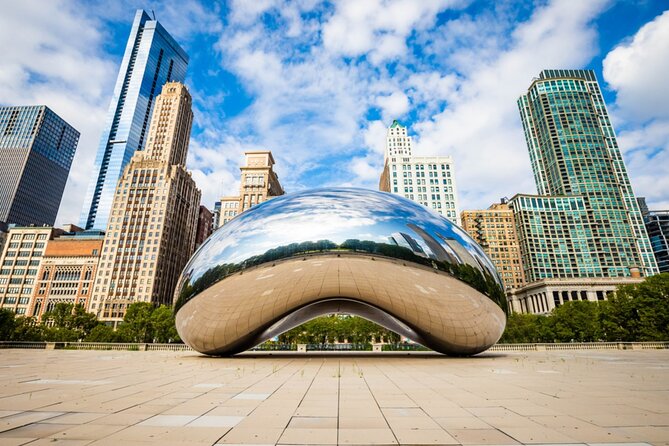
Cloud Gate is the most instantly recognizable stop. Anish Kapoor designed the 110-ton sculpture from polished stainless steel plates, shaped into a smooth, elliptical form. Its surface reflects the skyline, clouds, and people around it.
The clue at Cloud Gate should be easy to understand in principle, but this is also one of the busiest points on the route. You may need to move around the sculpture or wait for a clear view. If your group wants photographs, the advertised 95-minute duration can stretch.
The route’s famous sights are a strength, but they also create a possible problem. Crowds and temporary barriers can make it harder for the app to recognize your position. One reported experience involved construction blocking access and another location that required an expanded radius. Keep that possibility in mind, and do not treat hints as a failure. They are a practical backup when the real city does not match the app’s planned path.
More Heist and Spy Games in the USA:
- Bank Heist Escape Room Game for Private Group
★ 5.0 · 519 reviews - Chattanooga “Secret Agent” Escape Room Admission Ticket
★ 5.0 · 63 reviews - The Train Heist Adventure Escape Room
★ 4.5 · 35 reviews - Diamond Heist Escape Game in Miami Beach!
★ 4.5 · 17 reviews
Wrigley Square and the Millennium Monument

Wrigley Square offers a quieter change of pace after the best-known Millennium Park works. Its Millennium Monument is a nearly full-size copy of a semicircle of paired Roman Doric columns that once occupied this part of Grant Park from 1917 to 1953.
The square also includes a lawn and a public fountain. The stop gives you a look at how Chicago has repeatedly reshaped its public spaces. The columns are not ancient ruins, but they borrow an old architectural language to create a sense of civic ceremony.
The question here requires you to examine the site. This is a good place to pause and regroup, especially if your group has been focused on solving clues quickly. You can take a break at any point and resume later, so there is no need to hurry through the square.
Lurie Garden and Chicago’s buried past

Lurie Garden occupies a surprisingly engineered site. The ground was filled largely with rubble from the old city after the Great Fire, then framed and built above a parking garage. The garden was planned to tell a layered story about what lies beneath the modern park.
That detail gives the stop more weight than a simple garden visit. It connects the planted space to Chicago’s cycle of destruction, rebuilding, and ambitious city design.
The game asks you to find an answer on site before sending you onward. You might find this clue less obvious than one tied to a large sculpture, so look carefully and read the prompt twice. This is also a sensible place for a short break, though the total route involves enough walking that a long pause may make the later stops feel rushed.
The Chicago Stock Exchange Arch
Outside the Art Institute, the Chicago Stock Exchange Arch preserves one of the few surviving fragments of the 1893 Chicago Stock Exchange building. The original structure was designed during the same era when Chicago was presenting itself as a modern center of commerce, architecture, and culture.
The arch is easy to overlook beside larger attractions. That is exactly why it works well in a clue-based route. You are prompted to search for a detail with a direct link to the city’s architectural past, rather than focusing only on the most photographed places.
If you have already visited the Art Institute, this stop also helps connect the museum district to the broader story of Chicago’s architecture. You see how fragments of demolished buildings can survive in new settings.
Buckingham Fountain and the Grant Park monuments
Buckingham Fountain occupies a central place in Grant Park between Queen’s Landing and Congress Parkway. Dedicated in 1927, it is one of the largest fountains in the world and a major Chicago landmark.
The scale changes here. After the close-up work of examining sculptures and architectural fragments, Buckingham Fountain gives you a broad civic view. The clue asks you to look around and identify the answer needed to continue, but you should also take a moment to understand the setting.
The route then brings you to a seated Lincoln sculpture. The work shows Abraham Lincoln in quiet thought, gazing into the distance. Its mood is more reflective than the playful public art in Millennium Park.
Another stop is the Sir Georg Solti Garden, near Symphony Center, home of the Chicago Symphony Orchestra. The sculpture in this garden was moved to Grant Park and rededicated in October 2006. This detail shows how public art can change locations and acquire a new setting over time.
Taft’s Fountain of the Great Lakes provides another important stop. Completed in 1913, it was the first commission supported by the Benjamin F. Ferguson Fund, created to encourage statues and monuments along Chicago’s boulevards and public spaces.
Together, these Grant Park stops show a different side of the city. Millennium Park emphasizes newer art and interactive design. Grant Park adds fountains, civic monuments, music, and early twentieth-century public sculpture.
The Pritzker Military Museum and Library
The Pritzker Military Museum and Library is a nonprofit museum and research library on Michigan Avenue. Founded in 2003, it focuses on military history and holds specialist collections that include material linked to Winston Churchill and war-related sheet music.
The game includes the institution as one of its points of interest, but the activity does not include a guided interior visit or admission. Treat it as an outdoor wayfinding stop and a prompt to notice the range of museums along Michigan Avenue.
For anyone interested in military history, the short description may be enough to mark the building for a separate visit. The game itself keeps moving, so you will not receive the same depth that a dedicated museum tour would provide.
Price, group size, and practical value
At $7.20 per person, this is inexpensive for a downtown Chicago activity. A group of friends or a family can split the cost and spend roughly 95 minutes seeing many central landmarks without paying for a private guide.
The value is strongest when you want structure but do not need a human expert beside you. You get a route, challenges, historical notes, and the freedom to set your own pace. The price also makes it easier to accept a few imperfect clues or use a hint when the physical setting causes trouble.
The value is weaker if you want detailed architectural interpretation, personal stories, or smooth navigation at every turn. One poor experience involved blocked paths, difficulty reaching a fountain, and a group member unable to reconnect to the previous location. Another found the directions unclear and the questions too silly to justify the effort.
Those problems do not mean every game will fail. They do mean you should keep your expectations realistic. This is an app-led puzzle walk, not a professionally guided city tour. If a challenge becomes frustrating, use the available hint or expanded radius rather than letting one technical snag ruin the whole outing.
The game is private, available around the clock, and suitable for most people. Service animals are allowed, and the route is near public transportation. The start and end points are both in central Chicago, with the listed finish at the Fountain of the Great Lakes on East Jackson Boulevard.
Free cancellation is available if you cancel at least 24 hours before the scheduled start. Cancellations inside that window are not refunded.
Who should choose the Eastside Chicago Heist game?
I would recommend it to families with older children, friends who enjoy solving puzzles, and independent visitors who want a light layer of history during a downtown walk. It also suits repeat Chicago visitors who have seen Cloud Gate but want a reason to notice lesser-known pieces such as the Stock Exchange Arch or the Ferguson Fund fountain.
It is less suitable if you dislike smartphone activities, want a fully narrated tour, or have limited walking time. The directions may need patience, and construction can interfere with the intended route. You should also avoid planning it as a tightly timed connection between fixed appointments.
Should you book it?
Book this Chicago exploration game if you want a cheap, flexible way to connect major public artworks with less obvious Grant Park landmarks. The offline play, private format, and freedom to pause are real advantages, especially for families and small groups.
Skip it if your priority is polished navigation and expert commentary. At $7.20, the risk is small, but the experience depends on your phone, the app’s location range, and the condition of the streets on the day you play. Bring comfortable shoes, allow more than 95 minutes if you want to stop often, and treat the clues as a playful framework for seeing central Chicago rather than a substitute for a guided tour.
FAQ
How long does the Eastside Chicago Heist Exploration Game take?
The activity takes approximately one hour and 35 minutes. You may need more time if you stop for photographs, take breaks, or encounter construction or location issues.
Where does the game start?
The listed starting point is 111 South Michigan Avenue, Chicago, Illinois 60603, near the Art Institute of Chicago.
Where does the game end?
The listed end point is the Fountain of the Great Lakes on East Jackson Boulevard in Chicago.
Is a tour guide included?
No. This is a self-guided activity played through a smartphone app, so no physical guide accompanies your group.
Do I need an internet connection to play?
No. The game is designed to work offline, so an internet connection is not required for play.
Can I pause the game and continue later?
Yes. You can start at any hour, take a break at any time, and resume later.
What is the cancellation policy?
You can cancel for a full refund up to 24 hours before the experience start time. Cancellations made less than 24 hours before the start are not refunded.
Just added around the USA
- Maine: Belfast Family Treasure Hunt★ 4.0 · 4 reviews
- The Escape Game: Epic 60-Minute Adventures in Austin★ 5.0 · 8 reviews
- The Escape Game: Epic 60-Minute Adventures in Gatlinburg★ 4.9 · 7 reviews
- Outdoor Escape Room in Washington, D.C. – Adams Morgan★ 5.0 · 17 reviews
- Old Sacramento Scavenger Hunt Walking Tour and Game★ 4.5 · 3 reviews
- Nevada City Scavenger Hunt Walking Tour and Game★ 5.0 · 3 reviews
- Outdoor Escape Room in Sacramento – Downtown★ 5.0 · 4 reviews
- Mysteries on the Move: Scavenger Hunt in Savannah★ 3.5 · 13 reviews
City Exploration Games, compared.

Sibiu Old Town Exploration Game and Self-Guided Tour
Read our review →
Glasgow Ghost Hunt: The Soul That Got Away Exploration Game
Read our review →
Rotterdam Highlights & Spies: Interactive City Game
Read our review →
Discover Utrecht with a self-guided Outside Escape city game tour
Read our review →
Bristol Street Art: Banksy Exploration Game and Tour
Read our review →
Frankfurt Old Town & Emperors: City Game & Walking Tour
Read our review →
Browse the lists this tour appears in